

An eye on the future
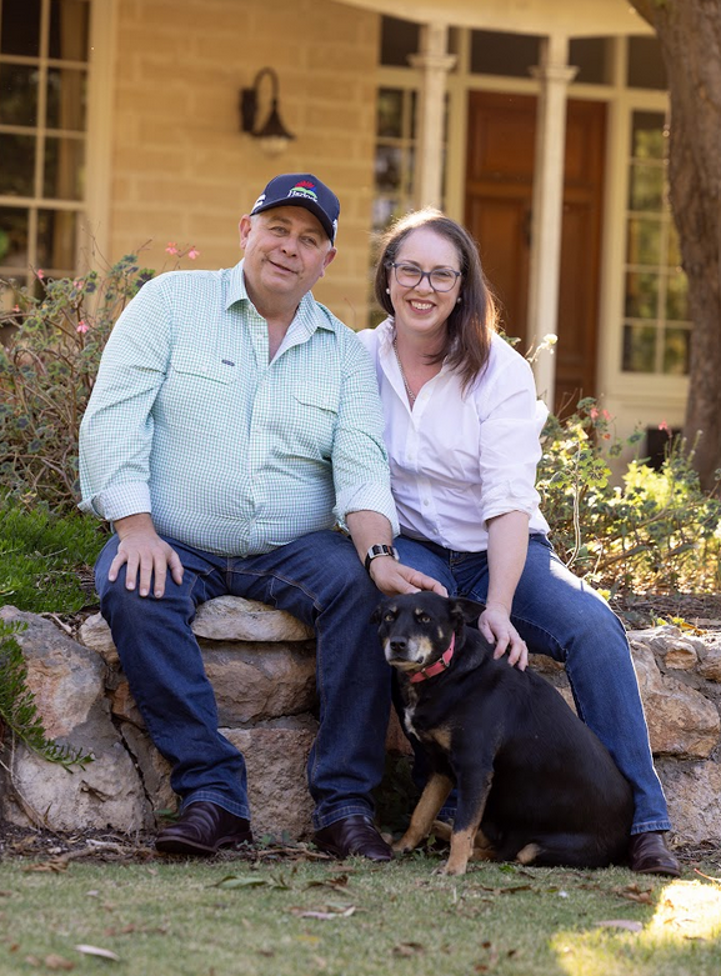
Scott and Fleur Harlock at Shepherd’s Way with Peggy, one of their seven kelpies. Photo: Adrian Gale
As a Warrnambool dairy kid Scott Harlock DipFM’94 just wanted to get off the farm and “do something different”.
His experiences overseas and interstate led him to Marcus Oldham College and a return to dairying, followed by life as a grazier and cropping contractor, as well as an industry and community leader with a passion for mentoring young people.
Early experiences helped broaden Scott Harlock’s outlook: a Year 12 exchange in the United States, followed by jobs in livestock at Deniliquin, on a fine wool Merino property at Cressy and at an irrigation farm at Finley.
A suggestion to pursue tertiary study led him to attend an open day at Marcus Oldham College and he enrolled in the Diploma of Farm Management in 1992.
Coming from a public school background into a cohort largely drawn from private boarding schools, Scott said he found residential living created a powerful peer network.
“It was all new to me,” he said.
“Everybody seemed to know somebody from school. But I found being on campus you had a stronger friendship and if you wanted to ask someone a question, they were just around the corner.”
Scott said that network had been an invaluable resource in the years since, with everyone readily sharing “the inside oil”, whether it was for assessing a potential farm purchase or sourcing livestock.
The course shifted his view of what it meant to be a farmer and opened his eyes to the range of careers available in agriculture.
“It probably solidified my thinking that farming is not just about how hard you work,” he said.
“It’s also about understanding risk and market dynamics, and making the right decisions and acting on them.”
For a time, Scott thought he might pursue a career in finance, before realising he preferred the hands‑on outdoors life to being choked by a tie every day in an office.
Scott’s practical year took him to a cotton farm at Gunnedah, followed by jobs on other cotton farms across northern New South Wales and Queensland.
From dairy to grazing
By the mid-1990s he was ready to return to the family dairy business near Warrnambool. It was then milking almost 900 cows across two properties and later expanded to 1200 cows across three farms.
Two of the dairies were run by sharefarmers, while Scott focused on support operations – fodder production, cropping and logistics – alongside milking duties.
The Millennium drought triggered a major shift. In search of reliable irrigation water, the family bought 800 hectares at Greenways in South Australia, and began transitioning into sheep and beef.
Over time, the business consolidated, selling dairies and outlying properties, and the partnership was wound up after the sudden death of Scott’s father, John, in 2018.
For the past 13 years, Scott and his wife Fleur have run beef cattle and sheep on their 890ha property, Shepherd’s Way, near Bool Lagoon in South Australia’s Limestone Coast region.
They have a self‑replacing Poll Hereford herd of about 280 breeders producing feeder steers for EU and pasture‑fed markets, and a Merino-composite based wool and prime lamb enterprise with 1450 ewes.
The system focuses on efficiency, guided by data, and in 2019 Scott began a contracting business in seeding and hay baling.
An adaptable approach
Adaptability remains a hallmark of his approach, with seasonal pressures driving changes such as adjusting calving programs to take the strain off the cows.
After two dry years with limited paddock feed – and facing the prospect of a huge hay bill – Scott said they weaned the calves from their mothers early and reared them on electronic feeders in 2025.
“That was an experience,” he said.
Beyond the farm gate, Scott’s commitment to agriculture extended to encouraging teenage dairy workers to pursue structured traineeships rather than leaving school early.
He has also taken up board roles with the Grasslands Society of Southern Australia and Mackillop Farm Management Group, and was Warrnambool State Emergency Service controller for seven years.
More recently, Scott became a director of the Stand Like Stone Foundation, which manages endowed funds supporting local grants, scholarships and education initiatives.
“I really joined to tick a box for me,” he said.
“I wanted something that was not industry and is out of my comfort zone. It’s challenged me more than I thought it would, so I find it good.”
Giving to Marcus
That willingness to contribute is also reflected in his ongoing connection to Marcus Oldham College.
Scott keeps in touch with classmates, including College Foundation chair James ‘Buff’ Bufton (DipFM’94) and 2018 Graduate of Excellence Award winner Richard Longbottom (DipFM’94), and has already supported the College through a donation to improve campus facilities.
Importantly, he and Fleur have also included a bequest to the College in their wills that will establish a testamentary trust and provide a scholarship for young women wishing to pursue a career in agriculture.
For the couple, who have no children and are now both “on the wrong side of 50”, according to Scott, the decision aligns with a strong desire to create opportunities for others.
They are also considering the future of their farm, and are open to potentially mentoring or vendor-financing a younger operator into the business down the track.
“We’d both like to stay here and see someone else prosper from our hard work as well,” Scott said.
This article appeared in MOCOSA
