

Barley scald back as disease resistance runs down
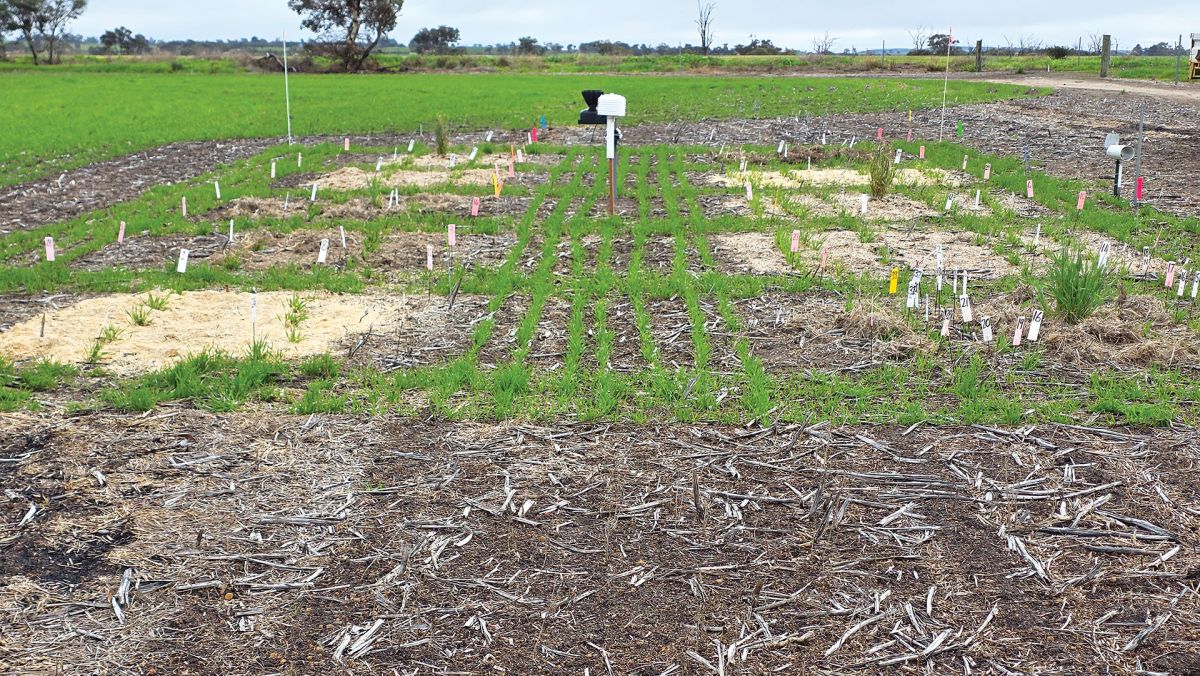
Testing barley scald virulence in barley plants with different stubble sources at the Tenterden field trial site. Photos supplied
Barley scald has moved from a background disease to a frontline management issue in Western Australia, with outbreaks being reported in varieties that had been considered reasonably safe.
That shift has prompted a fast-tracked GRDC National Grower Network investment with the WA Department of Primary Industries and Regional Development (WA DPIRD) to work out what has changed in the pathogen, how growers can protect crops now, and how to reduce the risk of further resistance breakdown.
The warning signs first appeared in 2024, when WA DPIRD annual disease monitoring picked up barley scald (Rhynchosporium graminicola) in several locations across eastern and southern regions.
By 2025, the changing pattern was entrenched. Reports were more frequent and it was turning up in lower-rainfall areas as far north as Northampton, and in varieties that had previously held up well against the disease.
GRDC Crop Protection Manager – West Jonas Hodgson says the issue could not be ignored. “In 2025 we started to see it much more regularly, and it was showing up in varieties that were previously moderately resistant to barley scald.”
That matters because resistance built into commercial varieties has done most of the heavy lifting against scald in WA for the past 15 years.
Before then, Mr Hodgson says scald was a known problem in the 1990s and early 2000s, with severe infections capable of causing major yield losses – up to 40% in susceptible varieties.

WA Department of Primary Industries and Regional Development Senior Research Scientist Dr Kithsiri Jayasena tests barley scald virulence in potted barley plants at the WA DPIRD Albany site.
WA DPIRD Senior Research Scientist Dr Kithsiri Jayasena says reports last year from the eastern and southern grainbelt showed scald not only on susceptible lines such as Laperouse, Titan AX, Combat and MinotaurA, but also in varieties growers would not have expected to be at risk.
“They found it on some of the more resistant varieties like Spartacus CL, Maximus CL, Neo CL and Zena CL,” he says.
It is a serious problem for WA growers, where plantings are dominated by just a handful of varieties.
Mr Hodgson says Spartacus CL, Maximus CL and Combat alone account for about 70% of barley planted in the state.
If resistance in widely grown varieties starts to give way, the impact can spread quickly across districts and farming systems.
Suspected genetic shift
At this stage, researchers suspect the scald population has shifted genetically, allowing some isolates to overcome resistance genes in current varieties, but Dr Jayasena says there is a lot they don’t know.
He says the outbreaks were thought to have been driven by a combination of pathogen change and production system pressure.
Barley scald can survive on barley residue for at least 2 years, so barley-on-barley rotations, retained stubble in no-till systems and a variety profile with limited resistance have created favourable conditions for scald to build.
“When you grow these varieties repeatedly, the pathogen tends to change anyway,” he says.
“In a tight rotation, one year after another year, the disease can multiply very fast.”
The GRDC-supported WA DPIRD project is seeking to learn more about the disease and develop management guidelines.
One part of the work led by Dr Jayasena is testing scald samples – which have been collected from infected stubbles – across a set of 10 popular barley varieties to see how they react to the current isolates.
Another is looking at fungicide performance, including seed dressings, in-furrow treatments and foliar sprays, to check which fungicide groups work well and how they should be used.
Field trials were established at Tenterden and South Stirling in May to compare fungicide modes of action and timings under local disease pressure.
Over-reliance trap
Dr Jayasena says the aim is not just to find products that suppress scald, but also to work out how to use them without developing fungicide resistance. This second point is critical. Growers have already seen what over-reliance on fungicides can do in barley spot form and net form net blotch (NFNB), where resistance has developed to multiple fungicide groups.
Testing has confirmed triple-resistant NFNB isolates in the South Stirling region, showing resistance to Group 3 (DMI), Group 7 (SDHI) and Group 11 (QoI) fungicides, as well as on the Yorke Peninsula of South Australia.
Mr Hodgson says it has been a clear warning against leaning too strongly on a single control measure.
“When we rely on singular varieties and singular genes for management of diseases, when they break down, they can break down quite rapidly,” he says.
“We want to make sure we learn from mistakes that have happened in the past, ensuring that we’re rotating chemistry and not relying on one pillar too heavily.”
The project is also digging into some of the unknowns that matter most in paddock decisions. Researchers want to better understand the diversity of scald isolates in WA, how agronomic factors could affect outbreaks, and how much yield loss current infections are causing.
They are also working towards more practical threshold-based recommendations to guide decisions about whether a fungicide spray is warranted.
While those answers are being developed, the interim message is to adopt integrated disease management and the Fungicide Resistance Five principles that are extended by GRDC’s Disease Management Extension Network.
Growers in affected districts should be cautious about relying on varietal ratings alone, especially where scald has already been observed in paddocks.
Rotating away from barley, reducing infected stubble carryover where possible – through grazing, strategic cultivation or longer breaks – as well as avoiding repeated use of the same fungicide group and thinking carefully about seed dressing and foliar chemistry combinations will all help reduce selection pressure.
Dr Jayasena says rotating crop types and varieties remains one of the most practical tools available.
“Using crop rotation, reducing barley-on-barley plantings and selecting varieties with good resistance are key strategies for lowering scald pressure,” he says.
Researchers are also urging growers and advisers to report suspected scald cases and engage with field days and extension events as findings emerge.
Dr Jayasena says the team is already coordinating events with grower groups and the Centre for Crop and Disease Management at Curtin University so growers are not left waiting for guidance until the end of the project in 2028.
This article appeared in GroundCover
