

Cover crops yield the goods
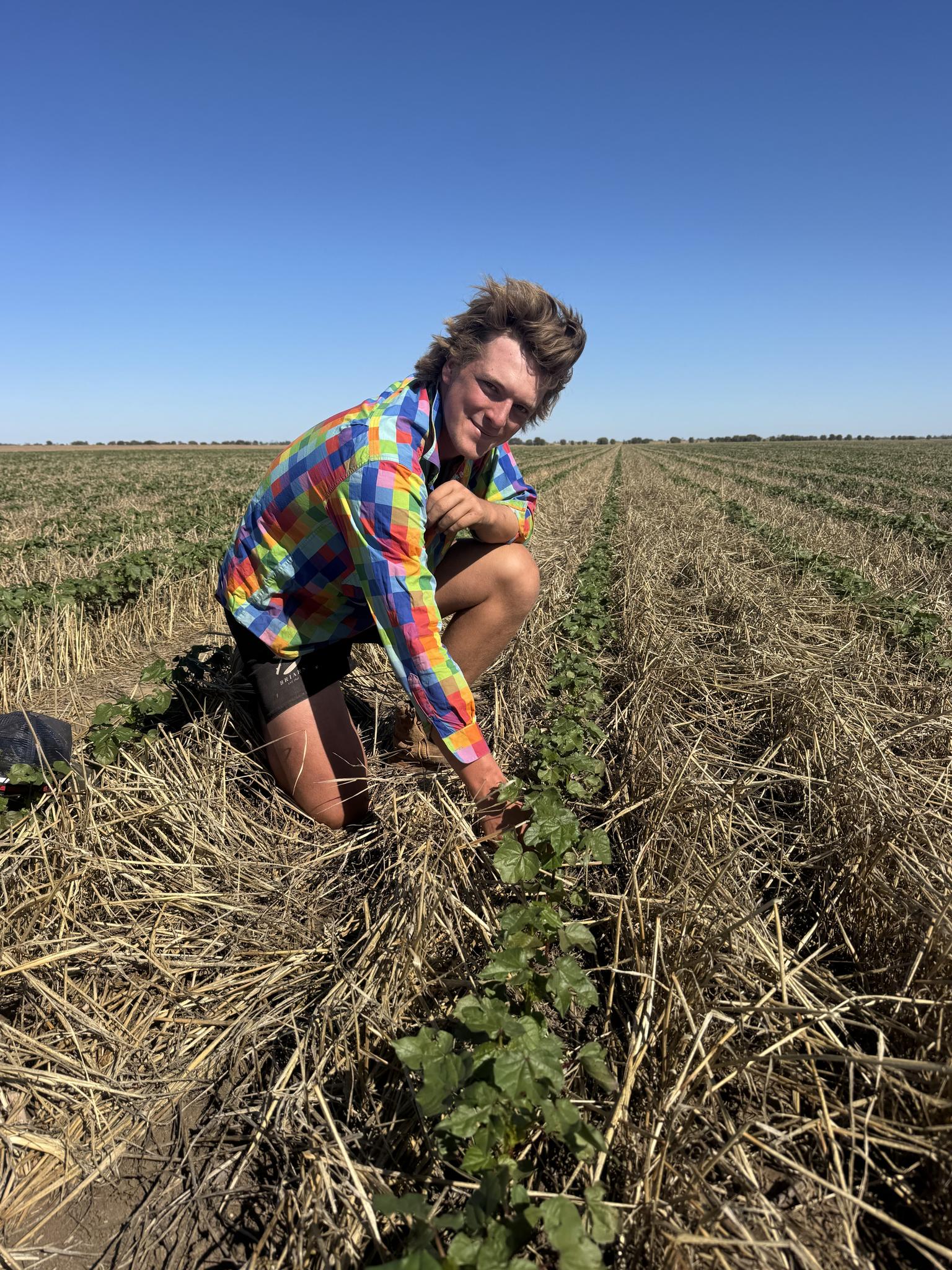
Tom Quigley with the cotton crop planted into a cover crop of wheat at Carina, Nevertire. Picture supplied
Adoption of cereal and legume cover crops has delivered significant benefits for cotton crops produced by the Quigley family.
The cover crops - usually wheat and faba beans - are sprayed out in late winter and left standing to create a favourable micro-environment that also collects water for cotton planted in the interrow.
Tom Quigley said the practice protected tender young cotton plants from wind and sandblasting, reduced thrip pressure, and cover crops of faba beans boosted soil nitrogen.
But not even bubble wrap could have saved some of last season's cotton from hail damage.
"It was a very good summer for growing irrigated cotton in this area," he said.
"Some crops in our agronomy group achieved really good yields of up to 18 bales per hectare, but we got hit with two different storms on two different farms either side of Christmas."
The hail affected 60 per cent of about 1000ha of cotton, with damage ranging from less than 10pc up to "total wipeout".
Fortunately, the crop was insured and 95pc was grown out.
"Cotton's a really amazing plant," Mr Quigley said.
"It can go from being very badly destroyed to still yielding something - it has an amazing ability to compensate but it can't fully recover."
The worst affected areas yielded 10 bales to the hectare, compared to average yields of about 16 bales per hectare for fields that escaped unharmed.
"We didn't have any significant quality downgrades last year," he said.
"We did see a very minute amount of high micronaire but nothing that wasn't expected from hail damaged cotton."
Mr Quigley farms with his wife Lauren, parents Tony and Sally, and brothers George and Richard along with their wives Emily and Alexandra, across several properties between Trangie and Nevertire, in the state's Central West.
"We also have a great team of people," he said.
"We have excellent staff who work incredibly hard, as well as our long-term agronomists Chris McCormack and Hamish Job."
Under the Quigley Farms name, they produce dryland winter crops of wheat, canola, chickpeas, faba beans and lentils, summer crops of irrigated cotton, and run a herd of Hereford and Angus cattle on land unsuited to cropping.
Soil types vary from soft, mild cracking clay to lighter red loam soils with clay subsoils that "grow beautiful dryland crops".
Average annual rainfall is about 500mm, although there has been a run of wetter years and "good water availability" since 2020.
Irrigation water is sourced solely from the Macquarie River out of Burrendong Dam, which was 54.9pc full in late November.
Crops are mostly irrigated by large and small pipe through the bank systems. About 10pc is flood furrow irrigated with siphons, and 50pc under lateral and centre pivot irrigators.
Since 2020, they have worked with surveyor and irrigation designer Michael McBurnie to switch some of the small pipes installed in 1996 over to large pipes.
Mr Quigley said the changes allowed for higher flow rates - with less waterlogging and better water use efficiency - and the capacity to automate more operations, as well as remotely monitoring and managing channels and pumps.
"We're pretty spread out," he said.
"We're made up of a few irrigation farms and to check a channel level might be a 60 kilometre round trip. Savings on diesel and tyres are awesome but it's mainly the time saving. And there's a big difference between being notified when an engine stops and coming back 12 hours later to a pump site that's been stopped for 11 hours."
Mr Quigley said they would ideally grow a wheat crop and then long fallow into cotton.
"We're increasing our irrigable area to move into a more one-in one-out situation," he said.
"But currently, with the cotton varieties we have and present diseases, we do push the envelope a bit on some back-to-back cotton when we have available water allocations.
"Typically, in the Macquarie Valley, we'll run into a long period of no water allocations and we'll get some forced fallows. So we're basically 'making hay while the sun shines', because at some point it's going to stop shining."
Last season's almost 1000ha of cotton included three of the new XtendFlex varieties - Sicot 761B3XF, Siokra 253B3XF and CSX1320B3XF - along with staple varieties Sicot 746B3F and Sicot 748B3F.
Mr Quigley said XtendFlex varieties were the industry's future.
"The wider herbicide tolerance options and being able to use different herbicide options in the fallow and in-crop has been extremely useful for us," he said.
"We're trying to get the most out of those varieties, growing them early enough, while we still have access to other varieties, so that we can learn how to grow them properly and get a good result with them."
Phosphate fertiliser is applied to fields equipped with lateral irrigators by strip tilling during the summer fallow period. Half the urea is spread at a rate of 330kg/ha just before planting and watering up. The rest of the urea is spread in November-December and watered in.
Using a Norseman precision planter, the 2024-25 cotton was planted from late September to early October at 15-16 seeds to the metre on one metre row spacings, with the aim of establishing 10-12 plants.
The Quigleys budgeted for 8.5 megalitres per hectare but used 15pc less last season.
In-crop herbicide sprays targeted fleabane, sow thistle and umbrella grass, and low incidences of verticillium wilt were observed.
The crop was picked from late March to mid-April and modules sent for processing to Australian Food & Fibre gins at Trangie and Warren.
This season's 850ha crop has battled intense thrip outbreaks, but Mr Quigley said the plants were starting to grow out of the damage.
"It's still early days," he said.
"It hasn't enjoyed the cold November, but we are getting a bit of heat now. We haven't necessarily had the best start, but the crop is still on track and could do anything, really. The result will depend on how good we are as farmers, and how many mistakes we make or decisions we get right."
This article appeared in Australian Cotton & Grains Outlook
