

From codling moth to fire blight and new varieties: how Stephen Tancred helped modernise apple growing
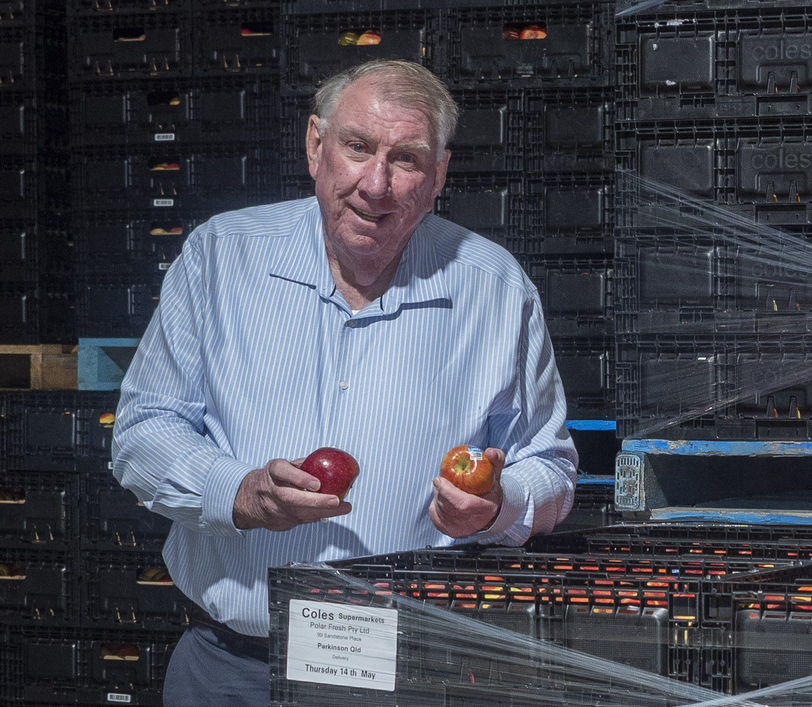
After ‘falling into’ apples as a young advisor, Stanthorpe consultant Stephen Tancred has spent four decades turning science into block-ready advice – and supported Australian growers in tackling some of the industry’s biggest challenges. Photo: Glenda Riley
If there’s a big issue on the horizon for
the apple industry, chances are Stephen Tancred has been somewhere near
the front of the room explaining it, running the numbers behind it or
quietly influencing the response
The Lifetime Achievement Award recipient didn’t set out to make a life in apples. Fresh out of university, he joined the Queensland Department of Primary Industries and was posted to Stanthorpe.
“The guy I was replacing was the apple adviser, so I fell into the crop that way,” he said.
“I had picked fruit when I was a university student up here in Stanthorpe, so I was happy to come here, but I arrived just after harvest had finished.
“There wasn’t much happening for five months and I originally thought it was a pretty boring crop.”
A couple of seasons set him straight. Discovering just how much happens in orchards – and how much science sits behind growing and storing good fruit – convinced him he’d landed in the right crop.
A scientist at heart, he is happiest when there’s a practical problem to solve and data to back the answer.
His research has ranged across breeding and evaluating new varieties, hail netting, irrigation monitoring, and developing integrated pest and disease management and plant growth regulators for fruit quality.
Career highlights include co‑breeding with Aldo Zeppa the Australian disease‑resistant apple, Kalei®, and being the first scientist to demonstrate the successful use of pheromone mating disruption to control codling moth in large commercial orchards.
That codling moth work marked a turning point for the industry, at a time when most orchards were spraying harsh insecticides every two to three weeks. Stephen and collaborating growers partnered with a Queensland manufacturer to trial slow‑release pheromone emitters that confused male moths so they couldn’t find females for mating. Publishing the successful results in 1991 helped underpin the cleaner, greener IPM programs growers now take for granted.
After 10 years with the DPI – at a time when government was reducing front line technical support – Stephen set up Orchard Services, an independent, multi‑disciplinary research and extension business that growers could trust.
As interested in sharing ideas as in pioneering them, Stephen has published 10 peer‑reviewed papers, 44 articles in APAL’s Future Orchards Library and, since 1984, has organised more than 60 field days and seminars in Queensland.
He has also presented at almost 40 major conferences and industry meetings for APAL, the Australian Fresh Fruit Company (AFFCO), Fruit Growers Victoria, packhouses and resellers, earning a reputation as an excellent communicator who can turn complex science into block‑level decisions.
Stephen’s scientific credentials have made him a natural advocate on biosecurity and water – two issues he regards as critical for horticulture.
When the industry formed a Fire Blight Taskforce in 2000 in response to New Zealand’s bid to export apples into Australia, he was invited on as a technical member – a position he held for more than a decade.
Stephen represented growers at a Senate inquiry, attended international fire blight workshops in New Zealand and Italy, and helped shape the arguments that led to strict import protocols, significantly lowering the risk of the disease entering Australia.
Community is also a big part of Stephen’s story. He helped form the Granite Belt Growers Association in 2018 to foster technical development, advocacy and provide a social support network, which proved vital for grower wellbeing during the 2019–21 drought.
Stephen has judged the fruit and vegetable section at the Stanthorpe Show for 42 years, is a past president of the Rotary Club of Stanthorpe, and is a keen supporter of the Apple and Grape Harvest Festival.
Now semi‑retired, Stephen still lives in Stanthorpe with his wife Peta Sheahan, and has a soft spot for a well‑grown Fuji as well as the local bakery’s apple slice.
Had he been asked straight up to accept being nominated for the Lifetime Achievement Award, Stephen would have refused it. Fortunately, longtime friend and fellow Lifetime Achievement Award recipient Rosie Savio knew him well enough not to.
“She tricked me into doing this,” he said. “She rang me and said ‘Stephen, I need you to do something for me … you’ve got to promise me that you’ll do this, it’s pretty important.’ I said ‘Yeah, sure, Rosie, what is it?’ She said ‘I want you to accept if I nominate you for an APAL award’. And I said ‘No’, but she said ‘You already promised!’.”
On reflection, Stephen said he was embarrassed by the recognition but “I’m also pretty proud of it”.
“It’s not why you do the work, but it’s nice to have the industry you’ve worked with all your life say thanks,” he said.
This article was published in AFG magazine and on the APAL website.
