

Going with a steeper flow
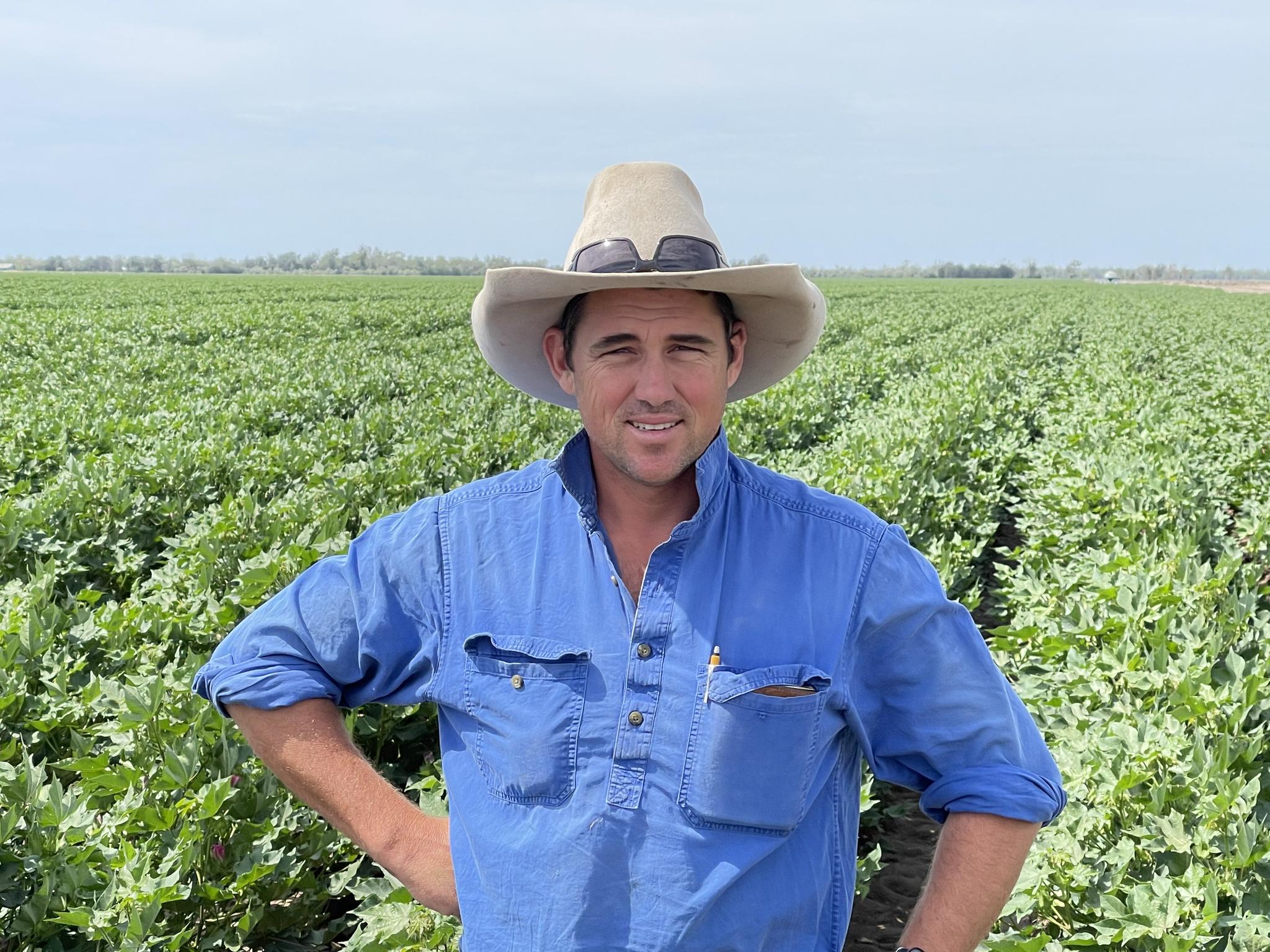
Charlie Clark in a field of Sicot 748B3F at Rugby, Billa Billa, Qld. Pictures supplied
When you're irrigating crops on steeper than usual ground, it can be tricky to ensure each plant gets enough water, especially on soils with lower clay content.
Through a process of trial and error, Billa Billa cotton grower Charlie Clark has adopted a system of putting water down every row to maximise yields.
Much of the farm has steeper gradients, with some as steep as 0.3 per cent grade, compared to the typical 0.05-0.1pc.
"We've found over a period of many years that we need to do that," Mr Clark said.
"The steepest of our country is twice as steep as what a traditional irrigation farm is.
"Not all of it, but a lot of it."
Charlie and brothers, Hamish and George, in conjunction with their parents Charles and Mannie, operate under the Clark Farming Group name.
Each of the brothers manage an aggregation in the NSW-Queensland border region.
They farm autonomously, but share some machinery, such as cotton pickers and transport equipment.
The financial side of the aggregation functions as a single business, providing advantages of scale and "power in numbers".
"We like to think we've got the best of both worlds," Charlie said.
"We're still a family organisation and we've got the ability to still have that family identity focus for our staff, but without having some of the complexities of corporate agriculture."
Charles and Mannie started growing dryland cotton at Benelawin, north west of Goondiwindi, in the early 1990s.
After the seasons became more variable in the early 2000s, the family bought an irrigation farm in 2012 and has grown cotton under irrigation every year since, except for 2019.
Charlie, who manages Rugby at Billa Billa, north of Goondiwindi, with his wife Jess and agronomic support from Tim Richards of MCA Ag, Goondiwindi, produces winter crops of wheat, barley and chickpeas, and summer crops of cotton and sorghum.
Soils are mostly self-mulching belah scrub soil.
Average annual rainfall is about 600mm, although less than 170mm was recorded during the drought year of 2019.
A run of 'kind' years
Mr Clark said the past four years had been "incredibly kind to us".
He said above average rainfall had delivered solid yields, although he doesn't expect that to continue.
"We're in for a hiding soon, but that's part of life," he said.
Preparations for last season's 400 hectares of cotton crops at Rugby began in early 2024 after the 2023 winter grain harvest.
Urea and Cotton Sustain were each applied at 400kg/ha pre-planting.
Another 100kg/ha of urea was spread in-crop before first watering, followed by 100kg/ha in a water run during the season.
Seed bed preparation begins in February and March.
"We try to run a one-in-one-out system with all our irrigation country, finding wheat directly after cotton allows us to maximise yield in the following cotton crop," Mr Clark said.
Crops were planted from mid-October using a John Deere MaxEmerge 1720 12-row planter on one metre row spacings at a rate of 14 seeds per metre.
Pests and disease weren't a huge issue.
Mirid levels were low to moderate and easily controlled. Unexpected late rain meant some areas needed treatment for silverleaf whitefly.
Crops are irrigated by a combination of bankless flood, lateral and pivot irrigators, with water sourced from overland flow via the Billa Billa and Mittengang creeks and held in on-farm storages.
Mr Clark budgets on eight megalitres per hectare of cotton across 10-11 waterings from 40 days after planting.
"We'll irrigate every seven days," he said.
"Every five to six in the peak if it gets really hot, and we're trying to keep the crop cool in 45 degrees, if we get that during summer, which we had a couple of years ago."
Rain creates havoc
Mr Clark said growing conditions were ideal for the cotton, with better than the 10-year average of day degrees and minimal days above 40 degrees.
"It was a great year and the cotton looked fantastic," he said.
"There weren't huge boll numbers, but what was there was really good size fruit, so we were in a good position."
Unfortunately, more than 150mm of rain in March, courtesy of the remnants of Cyclone Alfred, and another 65mm in April created havoc at picking, with major quality and yield downgrades, and machinery becoming bogged.
Mr Clark estimated discounts at $65 a bale on a significant portion of the cotton and said the rain cost about one bale a hectare, cutting yields to an average of 15.5 bales per hectare.
It was a bitter pill to swallow, but they had picked up enough water to more than offset the losses.
"It definitely created some opportunities for this year, so it's not the end of the world," he said.
After a wet August delayed preparation for the next crop, Mr Clark said they had pre-irrigated earlier this month.
He said they did so with a view to planting as close as usual to mid-October.
As well as 320ha of the staple varieties Sicot 748B3F and Sicot 606B3F, he intends to plant 100ha under pivots of the new XtendFlex variety, Siokra 253B3XF, and 200ha of dryland Sicot 619B3XF
Mr Clark said it would be interesting to see how the XtendFlex variety stacked up against the others which he said had performed well on his crops over a long period of time.
"The inclusion of the glufosinate trait will be somewhat of an advantage for us, but it's not make or break," he said.
Cotton modules are processed at Namoi Cotton's MacIntyre Gin, Goondiwindi,Qld.
In June last year, the gin marked a major milestone.
It recorded processing 30 million bales since it opened in 1962.
As it happened, the Clark family supplied the 30 millionth bale, something which came as a surprise.
"It was absolutely pure luck, as it was a reasonable season for the MacIntyre Gin," Mr Clark said.
This article appeared in Australian Cotton & Grains Outlook
