

High yields come at a price – met by diversity and intensity
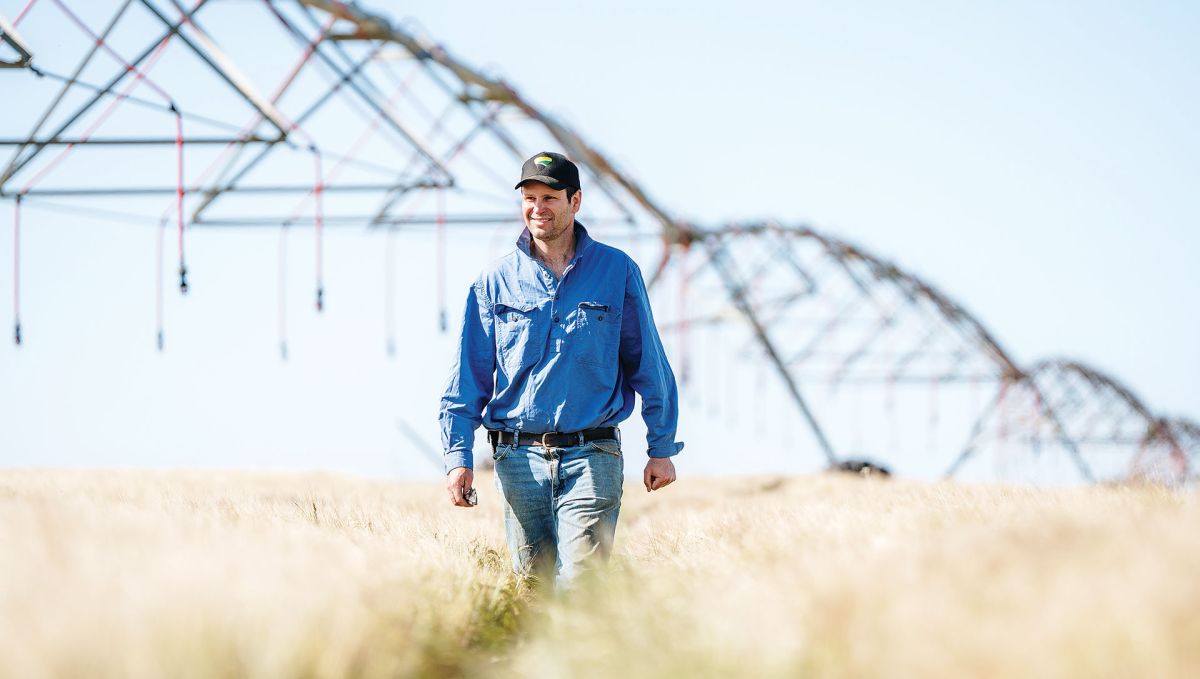
Angus Lyne runs a mixed enterprise with his family near Campbell Town, where irrigation across the drier months is crucial. Photo: Nick H Visuals
Flexibility is crucial to the Lyne family’s high-input farming system in Tasmania, where crop profitability is calculated on a rolling 10-year average.
The Lyne family – brothers Angus and Sam, their wives Lauren and Chloe, and parents Crosby and Poppy – produce a wide range of crops, along with wool, Merino and first-cross lambs, and Angus weaners, on 2,600 ha.
Angus, Sam and Crosby share responsibility for the various enterprises, with Angus managing the cropping side of the business and Sam and Crosby focusing on livestock, with support from a good team of staff.
Crops include barley, wheat, processing peas, poppies, potatoes and seed crops of grass, clover, chicory, canola, wheat, carrot and beetroot.
‘Riccarton’ was traditionally operated as a dryland sheep, cattle and cereal property until the early 2000s when irrigation was installed.
“Barley has always played a bigger role in the rotation,” he says.
“It has more flexibility, a lower cost of production and performs better under harsher environmental conditions than canola and wheat.”
Angus says he has favoured spring barley crops since the introduction of RGT Planet in 2017. Benefits include the shorter growing season, cheaper input costs and competition against weeds.
Spring barley also works well in a rotation with an autumn rape crop to fill the winter feed deficit and provides opportunities for later application of knockdown herbicides, he says.
Cost–price matrix
The Lynes determine crop profitability using a rolling 10-year average of yields and a cost-price matrix.
With weed control in mind, they will often use a grazing cycle, such as fodder brassica, rather than taking a risk on canola to do the same job.
Cereals are often planted after potatoes to take advantage of any nutrients and moisture left behind, with irrigated barley and wheat yielding up to 10 or 11 t/ha.
While growers in other medium and low-rainfall zones might be envious of those yields, Angus says the figures need to be put into perspective.
“We don’t necessarily make any more money than dryland growers because the cost to get that yield isn’t cheap,” he says.
“The smaller scale, the complexity, pivot infrastructure and high water costs put pressure on the viability of cereals, and that has led us into [a mix of] the higher returning crops to stay ahead.”
Preferred cereals include Neo CL barley, which they switched to in 2025 for its disease package, and the dual-purpose red wheat Longford.

Angus has favoured spring barley crops since the introduction of RGT Planet in 2017. Benefits include the shorter growing season, cheaper input costs and competition against weeds. Photo: Nick H Visuals
Flexible approach
“The rotation has to be flexible,” Angus says. “It’s like a constant game of chess throughout the spring to determine where it lands – the most profitable crops go into pole position, and we work our way down from there.”
The variable soil types at ‘Riccarton’ range from sand to heavy black and some red loam. Grid sampling showed acidic soil, with a pH of 4.9 to 5.0, so a long-term lime spreading program has been implemented to bring them up to 6.0 to 6.5.
Average annual rainfall is 500 mm, which is usually evenly spread throughout the year. Any variability creates challenges with trying to keep up with evapotranspiration in November and December.
A typical year at ‘Riccarton’ starts with the grain harvest from Christmas to mid or late February. The potato harvest runs from late March to early June, and from January until early November, various crops are planted.
Irrigation lifts intensity
Irrigation – initially drawn from local rivers – has been crucial for intensifying cropping in an area where additional land is too expensive.
Angus plans to expand the area under irrigation once the Northern Midlands Irrigation Scheme comes online late 2026.
The $218 million scheme will draw more than 25,000 ML of water each year from the underground Poatina hydroelectric power station, delivering reliable water to irrigators across central Tasmania.
In an average year, centre pivot irrigators deliver about 2,500 ML of water across the farm.
The livestock side of the business includes a self-replacing flock of 8,000 Merino ewes and a herd of 150 Angus cows, selling the calves to different markets depending on price and season.
As well as increasing diversity to reduce risk, the livestock are profitable in their own right and can also be a valuable weed management tool – the problem weeds being wild radish and annual ryegrass.
Whenever the weed seedbank gets too high, Angus says paddocks are either put into a grazing phase or sown with spring crops to allow for the use of herbicides with different modes of action.
Regular surveillance allows him to keep on top of pests such as slugs and common barley diseases that include net form net blotch and leaf scald.
Research yields benefits
While the cropping system at ‘Riccarton’ is very different to the mainland in terms of scale and complexity, Angus says a common challenge includes remaining profitable in the face of “the rising cost of everything”.
Research at the Tasmania Crop Technology Centre (Hagley), initially the Hyper Yielding Cereal Centre set up to showcase the GRDC’s Hyper Yielding Cereals Project trials, has helped Angus identify promising new varieties with high yields and disease resistance, as well as innovative agronomic practices to improve farm profitability.
In the 2023 Hyper Yielding Crop Awards, the Lynes produced the highest-yielding commercial barley, a spring crop of RGT Planet, which yielded 10.69 t/ha.
Angus regularly visits the Field Applied Research Australia-managed centre at Hagley to monitor how crops are performing and see how the different varieties respond to products such as herbicides and plant growth regulators.
This article appeared in GroundCover
