

Juggling act at Nevertire
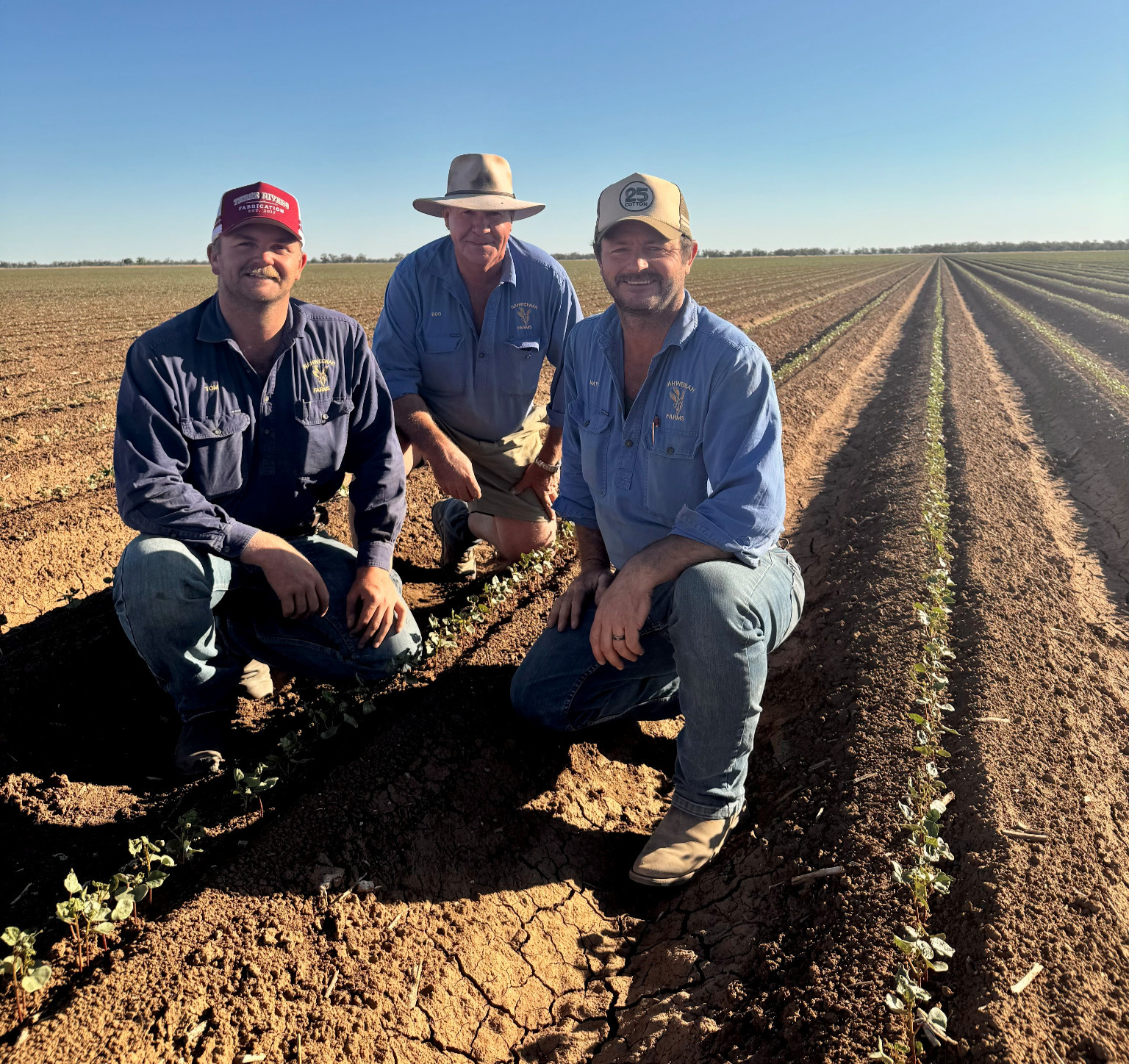
Tom, Kim and Matt Russ in a field of October-planted Sicot 746B3F cotton. Picture supplied
Nevertire mixed farmer Matt Russ doesn’t mince words with his assessment of the 2024-2025 cotton season.
“It was a train wreck,” he said.
“Everything got hailed ... 50 per cent of the crop was completely wiped out. It absolutely smashed it to pieces.”
That February 9 storm also blew over a neighbour’s lateral irrigator and destroyed sheds, and Mr Russ said they were lucky to have lost only cotton.
Mr Russ farms about 4000 hectares of cropping land with his father Kim and brother Tom across three properties, Nahweenah, Caroona and Quondong, near Nevertire, in NSW’s central west.
They produce winter crops of wheat, canola, monola, chickpeas and faba beans, and summer crops of irrigated cotton on a 3m controlled traffic farming system (CTF).
The Russ family also runs a herd of 350 Hereford breeders which are joined to Ironbark Hereford bulls. Offspring are weaned onto a beardless grazing wheat, such as Naparoo, and once they meet Coles’ specifications are trucked to the JBS Australia abattoir at Scone.
Soil pH ranges from 6.2-7.2, and soil types vary from sandy ridges to clay loams and some hard-setting red clay, which they deep rip and spread with variable rate gypsum.
Average annual rainfall is about 480mm, and four out of the past five years have been above average.
But Mr Russ said summer rainfall was not as reliable as in areas such as Moree, so growing cotton was wholly reliant on the Trangie-Nevertire Irrigation Scheme which delivers water from Burrendong Dam on the Macquarie River.
“Generally, we’ll grow 200ha of cotton,” he said.
“Sometimes it might be 300ha if we’ve got a decent water allocation, but we’ve only planted 190ha this season.”
The cotton is mostly flood furrow irrigated with siphons, augmented by two centre pivot irrigators at Nahweenah.
The preferred varieties are Sicot 746B3F and Sicot 748B3F, which perform well in the region, although Mr Russ said he was keen to try the new XtendFlex varieties, especially under the centre pivots.
“To use the chemicals that you can use, we have to apply by ground rig,” he said.
“Pulling down the Rotobucks and moving the siphons gets a bit tedious to do this time of year. Fleabane is the main weed we struggle with in the cotton. It’s become quite resistant to Roundup, and it’s very hard to kill.
“If we’ve got to take a bit of a hit there somewhere to try and get on top of these weeds, that may just be what has to happen. We can’t keep doing things the same and then have the fleabane and the windmill grass and all these weeds getting on top of us. We’d get ourselves in a proper pickle.”
The Russes have embraced controlled traffic farming in a quest for efficiency and better soil health.
They started with the dryland cropping portion in 2021 when they bought two 18m Midwest draper fronts to match their 18m John Deere seeder and 36m John Deere self-propelled sprayer operating on 3m tramlines.
They now have three tractors on 3m spacings and have switched over their cotton gear to nine 1m row spacings on irrigated land.
As well as reducing bogging, Mr Russ said the change had helped minimise dust when summer spraying.
Preparation for cotton each year is “somewhat similar” in the flood irrigation country.
The routine includes ripping at 90 degrees across the paddock – usually into wheat stubble – and pulling up rows by April, then allowing the field to fallow over winter.
“We try not to grow back-to-back cotton if we don’t have to,” he said.
During July-August they spread 150-200kg/ha of mono-ammonium phosphate (MAP), followed by 350kg/ha of urea up front, worked in with a set of Lilliston rolling cultivators. The remaining urea required is water run in January-February
The 2024-2025 Sicot 748B3F cotton crop was planted dry on the October long weekend, using a nine-row John Deere MaxEmerge 5 planter at 16 seeds to the metre on 1m row spacings, and watered up three days later.
Mr Russ said they budgeted on 8.5 megalitres per hectare, but were willing to buy temporary water if needed to finish a crop.
Last season’s crop had been watered six times before the hail struck.
“We mulched half of it in, and the insurance company made us grow out the other 50pc, which got a finishing irrigation in late February,” he said.
“The crop was picked on the 16th of April. It only ended up yielding about six bales to the hectare, but we were insured and we were paid out at 15 bales.”
Disease pressure was low and no extra insecticide sprays were needed.
Modules were sent to the Australian Food and Fibre gin at Warren for processing.
This season’s crop of 190ha of Sicot 748B3F cotton was planted October 3-6, watered up on October 9 and likely to get its next irrigation in late November, depending on rainfall.
Mr Russ said water allocations had risen slightly from 10pc in July to 27pc in November, with Burrendong dam currently at 58pc, but the outlook for cotton prices was less favourable.
“Today’s price out of AFF is $559 per bale which is not exciting me very much,” he said.
“With high costs of fertiliser – high cost of urea, high cost of MAP – and the high costs of machinery ... it’s a constant battle. We need to be growing 14 bales-plus to really make a go of it.”
This article appeared in Australian Cotton & Grains Outlook
