

Mallee family lifts yields with flexible rotations and strict weed control
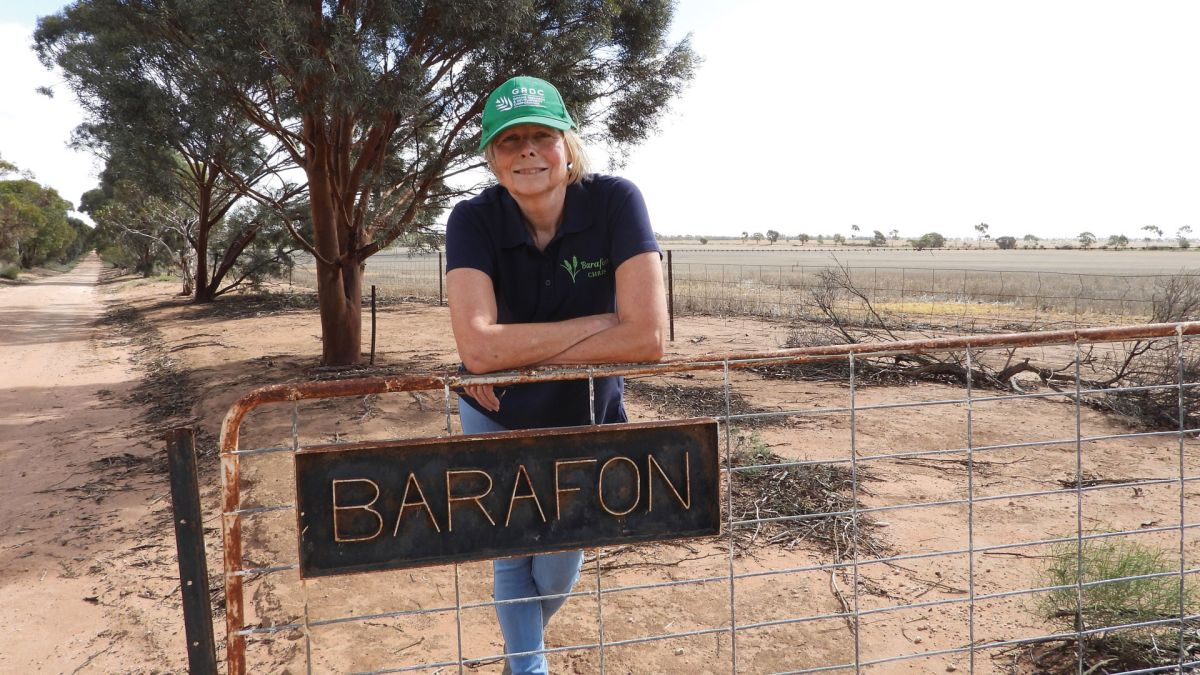
Christine Plant crops 3,350 ha south-west of Manangatang with husband Keith and son Brad. Photos: Sandra Godwin
Farm snapshot
Owners: Keith and Christine Plant, Brad and Donna Plant
Farm location: Manangatang, Victoria
Area cropped: 3,350 ha
Average annual rainfall: 290 mm
Soil types: sandy rises, mid-slopes and heavier flats
Topography: undulating
Soil pH range: highly variable, more acidic on rises, closer to alkaline on flats
Enterprises: cropping
Crops: dryland wheat, barley, lentils, chickpeas and brown manure field peas
Typical crop sequence: flexible – brown manure or legume, wheat, barley
Flexible rotations, on-farm storage and an uncompromising management of weeds have helped the Plant family build a resilient cropping enterprise in the Victorian Mallee.
Keith and Christine Plant crop about 3,350 ha, with their son Brad managing day-to-day operations at ‘Barafon’, south-west of Manangatang.
Christine says the family’s focus is on making the most of every millimetre of rain that falls on their mix of sandy rises, mid-slopes and heavier flats.
Average growing season rainfall is modest – around 290 mm – and 2025 was “very dry all the way through”. Just 107 mm was recorded for the growing season and 202 mm for the year on their home block.
Despite this, barley yields have trended higher over the past decade and wheat has remained above average, underpinned by stored subsoil moisture, grain legumes and vigilant summer spraying.
Last year’s wheat averaged 3.1 t/ha compared with the 5-year average of 2.85 t/ha and the 10-year average of 2.72 t/ha. Barley yielded 4.2 t/ha compared with the 5-year average of 3.56 t/ha and 10-year average of 3.13 t/ha.
“That was actually the second-best barley yield we’ve ever had,” Christine says.
“We were amazed because we had such a low growing season rainfall, but what we had was subsoil moisture.”
By contrast, lentil and chickpea yields were below average. Lentils yielded 1.1 t/ha compared with the 5-year average of 1.4 t/ha and chickpeas yielded 0.6 t/ha (0.9 t/ha).
The Plants are hoping to address this using a ripper designed by Brad and built with his father, Keith.
The ripper has been designed to cope with thick stubble and rip to 600 mm. It will penetrate the hardpan and make it easier for legume roots to reach soil moisture at depth.

Building silos has increased their ability to make strategic decisions, says Christine Plant.
Rotations built around legumes
The Plants grew their first chickpea crop in 2013, then introduced lentils in 2016. Chickpeas were brought back in 2018 to diversify income and ‘grow’ their own nitrogen.
The 2026 program is about 38% barley, 23% wheat and 30% legumes, including lentils, chickpeas and brown manure field peas.
Christine says they haven’t grown canola as a break crop since 2018 because it proved to be unreliable in a low-rainfall zone and expensive to grow. Instead, legumes and brown manure add rotational flexibility and underpin their nitrogen strategy.
Paddocks of chickpeas, lentils and field peas are followed by cereals, typically wheat and then barley.
That pattern can change depending on stored moisture, prices, how much legume stubble is in the system, soil type and weed pressure, although this is generally kept low.
“We usually have 4 blocks of legume stubble and then we’ll put cereals on those, usually wheat,” she says.
“We don’t necessarily follow a set rotation as such. We’ve got some flexibility, depending on a particular block’s history.”
While some growers have decided against sowing their full program because of high urea pricing and potential lack of availability due to conflict in the Middle East, Christine says they have enough seed, fertiliser and fuel on hand.
The only change has been switching a planned barley paddock to brown manure field peas.
Variety emphasis on quality and yield
Hammer CL Plus is the backbone of the Plants’ wheat program, delivering H2 or H1 protein in most years.
This season they have added Tomahawk CL Plus, an Australian Premium Wheat, in a bid to lift tonnage late in the marketing year when protein premiums are less compelling.
“We find you get a bit of a premium for protein early in the season and then later in the season – wheat is wheat,” Christine says.
“We’re thinking Tomahawk CL Plus is a higher-yielding variety compared to Hammer CL Plus.”
The preferred barley variety is Maximus CL and lentil paddocks have been sown to GIA Thunder, while the new field pea variety APB Bondi is being bulked up for seed alongside blocks of PBA Oura.
The Plants have transitioned from a tyne seeder on 304 mm (12-inch) spacings to a disc seeder at 190 mm (7.5-inch) spacings to improve crop competition and stubble handling.
A John Deere header with a Shelbourne stripper front leaves tall standing straw at harvest, which the disc unit can work through without blockages that would challenge wider tyne configurations.
"We like to keep the stubble there because it shades the ground and hopefully conserves moisture," Christine says.
Managing inputs
Nitrogen and phosphorus strategies have evolved with the move to a strip-and-disc system.
With a tyne seeder, more urea was applied at seeding. Now the focus is on modest rates at sowing and higher in-crop applications guided by yield maps and variable-rate technology.
Base fertiliser at seeding includes monoammonium phosphate followed by sulphate of ammonia after seeding, with extra nitrogen applied during the season as conditions warrant.
The family hosts on-farm trials and collaborates with research groups, including Birchip Cropping Group and GRDC National Variety Trials. Soil acidity is an emerging issue on some rises, and the Plants have begun spreading lime.
They’re also testing different crop types, including maize, sorghum, barley, lucerne and mixed species in summer to soak up excess moisture from seeps and stop them from expanding.
Marketing flexibility
On-farm storage has transformed the business’s marketing options.
The Plants can now hold about 9,000 t of grain in silos, backed by silo bags when needed. Two new flat-bottom silos, each holding almost 1,750 t, have reduced their reliance on bags and the workload involved in checking and patching for mouse and fox damage before rain.
Much of the grain is sold ex-farm, with buyers organising the trucks. The main domestic market is nearby feedlots, while high-protein wheat is sold to domestic and export buyers.
Rising freight rates and fuel levies have sharpened the focus on ex-farm contracts, which build transport costs into the delivered price.
This article appeared in GroundCover
