

New rust strain adds to Tasmania’s cropping complexities
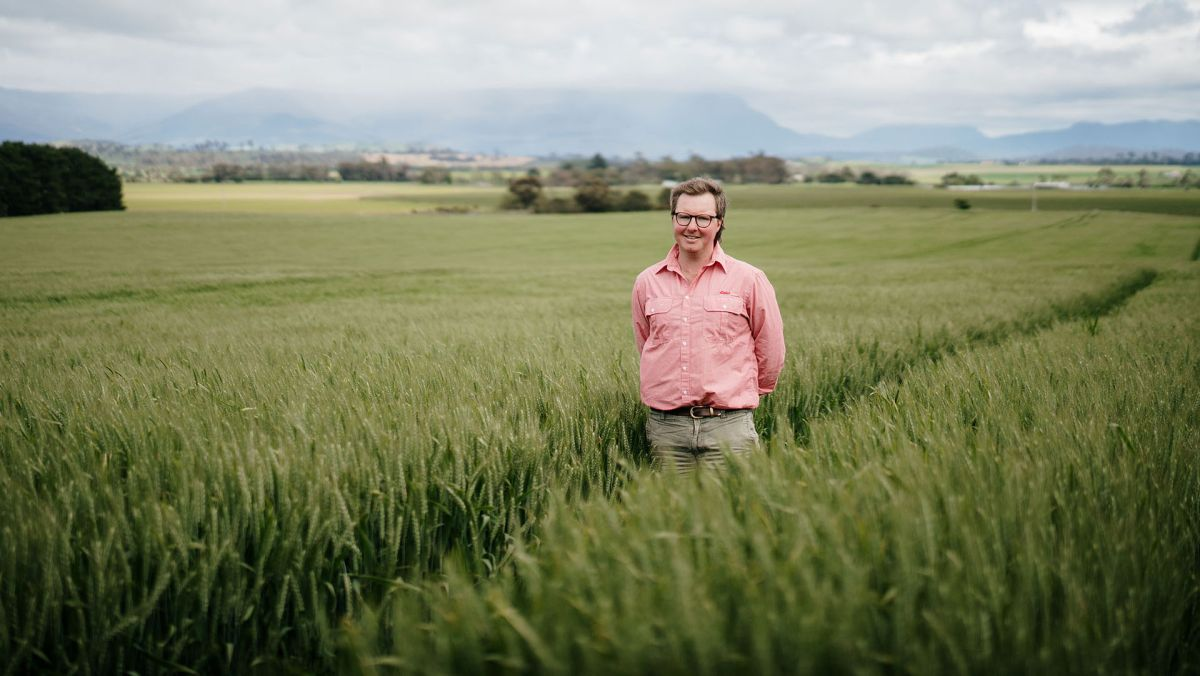
In July 2022, Tasmania’s first outbreak of stripe rust 239 strain in wheat crops was identified by agronomist Ross Tulich, triggering a region-wide revision of disease management practices. Photos: Nick Hanson
During July 2022, Elders Launceston agronomist Ross Tulich was driving around his territory when he saw what appeared to be aggressive stripe rust in very young wheat plants near Cressy.
“To see rust in Tassie in the middle of winter with the weather conditions we were having, in crops that were immature and not at row closure or ground cover yet, was really quite bizarre,” he says.
He sent samples off for pathogen screening to the Plant Breeding Institute at the University of Sydney’s Sydney Institute of Agriculture, which identified the cause of the observed symptoms as the 239 strain of stripe rust.
Thought to have originated in Europe, the pathogen was first detected 5 years earlier in samples of stripe-rust-infected wheat collected at Normanville and Horsham in Victoria. It became the fourth strain to reach Australia since the first stripe rust detection in 1979.
The new Tasmanian normal
Mr Tulich’s discovery was the first time 239 had been documented in Tasmania. It has quickly become an annual challenge for growers, who have been forced to revisit varietal selection and spray timing.
“It was hitting a lot of our newer varieties that we thought were more resistant to stripe rust, such as RGT Accroc and RGT Cesario,” he says.
“We thought they had really good new disease packages in them, but they were proven to be really susceptible.”
Intensive fungicide use was not enough to stop the disease in its tracks during that first season. However, Mr Tulich quickly learned which active ingredients were more effective than others.
The combination of a run of warm, wet seasons, the existence of a summer ‘green bridge’ of host plants, and common use of pivot irrigation has provided favourable conditions for rust survival and spread in the years since.
“After seeing the severe crop damage the 239 strain caused in 2022, you’re always keeping a lookout for it,” he says.
“As soon as crops are harvested, there’s grass or forage crops that go straight back in over summer to grow feed for the livestock portion of farmers’ businesses. So, we don’t really get that natural drought that takes the green bridge out and we’re always seeing high disease pressure.”

Ross
Tulich says there is no such thing as a typical cropping rotation in
Tasmania. Many growers produce cash crops each year, such as potatoes,
poppies or other vegetables (for example, carrots, onions, peas and
beans), as well as cereals and seed crops.
Complex farm systems and challenges
Stripe rust isn’t the only threat to grain crops in Tasmania. Scald, net form net blotch and spot form net blotch in barley; Septoria tritici blotch in oats and wheat; and pest issues – from redlegged earth mites to damage by deer, wallabies and birds, including ducks, swans and cockatoos – require a whole-of-farm approach and innovative solutions.
It doesn’t matter what district farmers are farming in, they’re battling game damage in their cereal paddocks.
Strategies range from hiring professional shooters with the appropriate permits, to significant investment in kangaroo and wallaby-proof boundary fences.
As a Senior Agronomist at Elders, Mr Tulich specialises in broadacre crops, which includes cereals, vegetables, potatoes, seed crops, pastures and forage crops.
“There’s a huge amount of variation just in my area,” he says. “There’s huge variation in rainfall and huge variation in soil type.”
Mr Tulich says there is no such thing as a typical cropping rotation in Tasmania. Many growers produce cash crops each year, such as potatoes, poppies or other vegetables (for example, carrots, onions, peas and beans), as well as cereals and seed crops.
“And then a lot of farmers are mixed enterprises, so they have either prime lamb or cattle,” he says.
“The farms are quite complex. A general rotation would have cereals following potatoes, and I believe that is a large factor in how we can get strong yields by using the legacy fertiliser from the potato crop prior.
“We throw a lot of fertiliser at the potato crops due to their high nutritional requirements, so there’s always quite a bit of phosphorus left over.
“And then, if we can get through winter without the cereal crop getting too waterlogged under irrigation, we can achieve pretty good yields.”
Australian Cereal Rust Control Survey
Growers and advisers who see signs of rust in cereal crops or on volunteer cereals and grass weeds can submit samples for pathotyping to the Australian Cereal Rust Survey.
The Australian Cereal Rust Survey is supported through GRDC investment in the Australian Cereal Rust Control Program.
This article appeared in GroundCover
