

Opportunity in diversity for Tasmanian growers
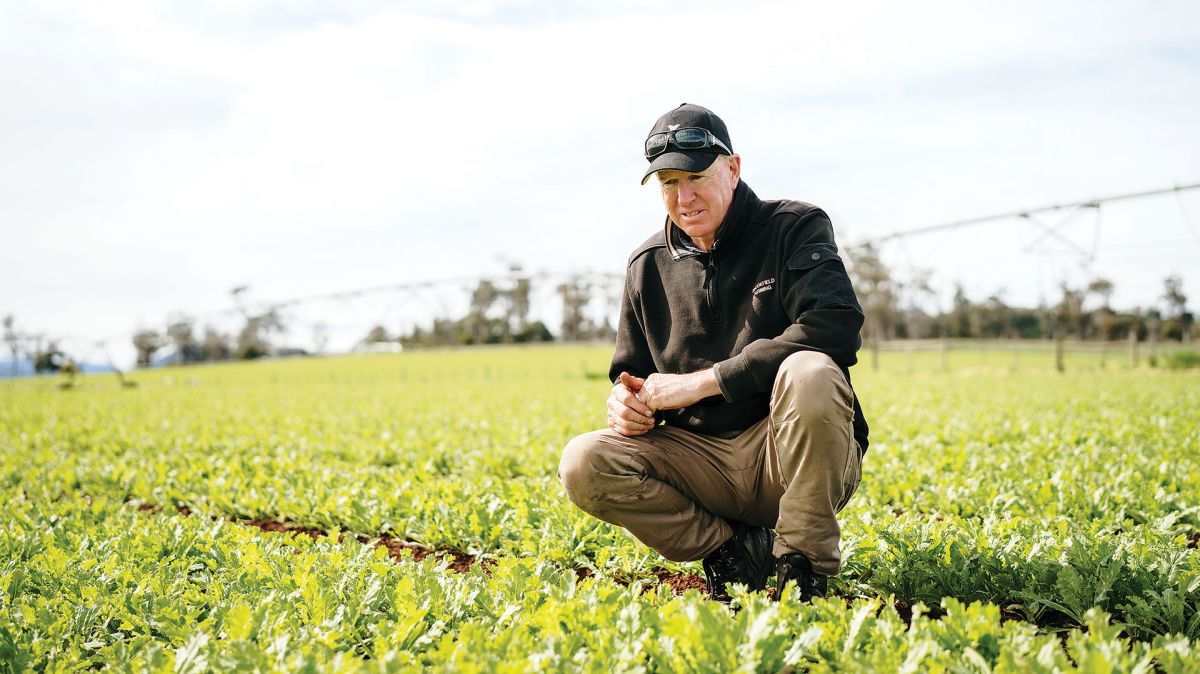
Nathan Richardson, on his property in north-west Tasmania, focuses on diverse crops and livestock. Photo: Nick Hanson
Diversity is essential for growers in north-western Tasmania where wheat, barley and oats are mixed with horticulture crops and livestock
Embracing a diverse range of enterprises is the best way to run a successful business when you have a small farm with access to abundant, secure water.
Tasmanian grower Nathan Richardson maximises diverse cropping, irrigation and livestock enterprises at ‘Brookfield’, Thirlstane.
The Richardsons crop about 90 ha of the 125 ha property – bought in 1965 by Nathan’s grandparents, Hedley and Gladys. They balance grain production and livestock with longstanding contracts in the potato and poppy industries.
Crops include wheat, barley, oats, maize, poppies and potatoes. Hay and silage are supplied to local dairy farmers, with some retained to feed livestock.
Farm conditions
“It’s an average-sized farm for the district we’re in,” Nathan says.
“It’s the diversity of enterprises that can be managed in Tasmania that makes small holdings, in my opinion, quite profitable. We can pretty much graze and grow crops all year round. We have dry periods, but we’re pretty confident it’s always going to rain in Tasmania.”
Annual rainfall averages approximately 800 mm and water use is typically 100 ML a year, but can range from 50 to 180 ML.
Dry periods such as 2019 (481 mm) and 2023 (437 mm) were challenging.
Nathan says they used all their irrigation allocation from the Sassafras Wesley Vale Irrigation Scheme and “got a good look at the bottom of our dams” in 2023.
“But generally speaking, in our district, we make more money in a dry year than an average or above-average rainfall year, purely because we have the ability to irrigate,” he says.
“In a low-rainfall year, it’s generally going to be sunnier and warmer and crops love that.”
Cereals typically receive 0.5 to 1 ML/ha, if needed. The thirstiest crops are potatoes (4 to 6 ML/ha) and poppies (2 to 3 ML/ha).

Nathan Richardson says chicken litter has been valuable for restoring micronutrients, improving both soil health and crop yields. Photo: Nick Hanson
Enterprise shifts
Until 2005, ‘Brookfield’ was home to an intensive vegetable operation, but falling profitability inspired the Richardsons to switch to cereals and livestock.
Benefits included easier management, less cultivation, significantly less pesticide use and the opportunity to both graze and harvest dual-purpose cereal crops.
Importantly, the mix allows them to have direct relationships with buyers, including butchers in Launceston and Hobart for meat products, and Turner Stillhouse, which uses their maize in its new Rosevears Tasmanian Three Grain Whiskey.
Shifting soil health
The Richardsons learned about fertiliser from their experience with chickens. In the past, the farm also ran broiler chickens, which provided litter that has been beneficial for the ironstone-based soils.
As well as a good history of liming, which has helped bring soil pH up to 6.4 and above, Nathan says spreading 5 to 8 t/ha of chicken litter has been valuable for restoring micronutrients, improving both soil health and crop yields.
“We’re cautious not to apply high amounts before poppies and some winter wheat, because it can produce lush vegetative growth that can be susceptible to disease,” he says.
“But we have found that oats, barley, potatoes and pasture absolutely love chicken litter.”
Potatoes are often followed by a cereal to mop up residual fertiliser, which contributes to grain yields of 8 to 10 t/ha “reasonably easily”.
Integrated management
Overall, the rotation is flexible and designed to manage weeds, pests and disease using integrated management principles.
Weeds include wild radish and wild turnip in wet springs, and the main pest is armyworm. Pressure from diseases such as net form net blotch, leaf scald, eyespot and differing strains of rust depends on seasonal conditions.
“In the long run, we’re seeing the benefits of identifying problems, monitoring them and acting at a certain threshold, rather than jumping the first time you see a problem,” he says.
“Some years we don’t spray, other years we do, and that is a seasonal thing.”

Nathan Richardson maximises diverse cropping, irrigation and livestock enterprises. Photo: Nick Hanson
Focus on priorities
Farmland in the area is prohibitively expensive and rarely available, so the Richardsons have embarked on underground drainage projects to expand the area suitable for cropping at ‘Brookfield’.
Grain crops for 2025 include 20 ha of RGT Waugh wheat, 12 ha of RGT Planet barley and 24 ha of Graza 85 forage oats, for either grazing, silage, hay or grain production. About 14 ha of poppies and 10 ha of potatoes were planted in October. Maize is usually sown in late October to early November.
As a small-scale cereal grower, Nathan says he values the work of organisations such as GRDC and Southern Farming Systems in research and developing high-yielding varieties with suitable traits.
“It’s really important that we continue research, because we’re doing more with less and feeding more people,” he says.
“When we started getting into wheat growing 25-odd years ago, we thought 5 to 6 t/ha was fantastic. Here we are, 25 years later, getting 7 t barley crops dryland and 8 to 10 t wheat crops without worrying about things too much. If you really want to have a crack, you can get 12 t barley crops and 13 or 14 t wheat crops. I think it’s great.”
This article appeared in GroundCover
