

Orchards of the future
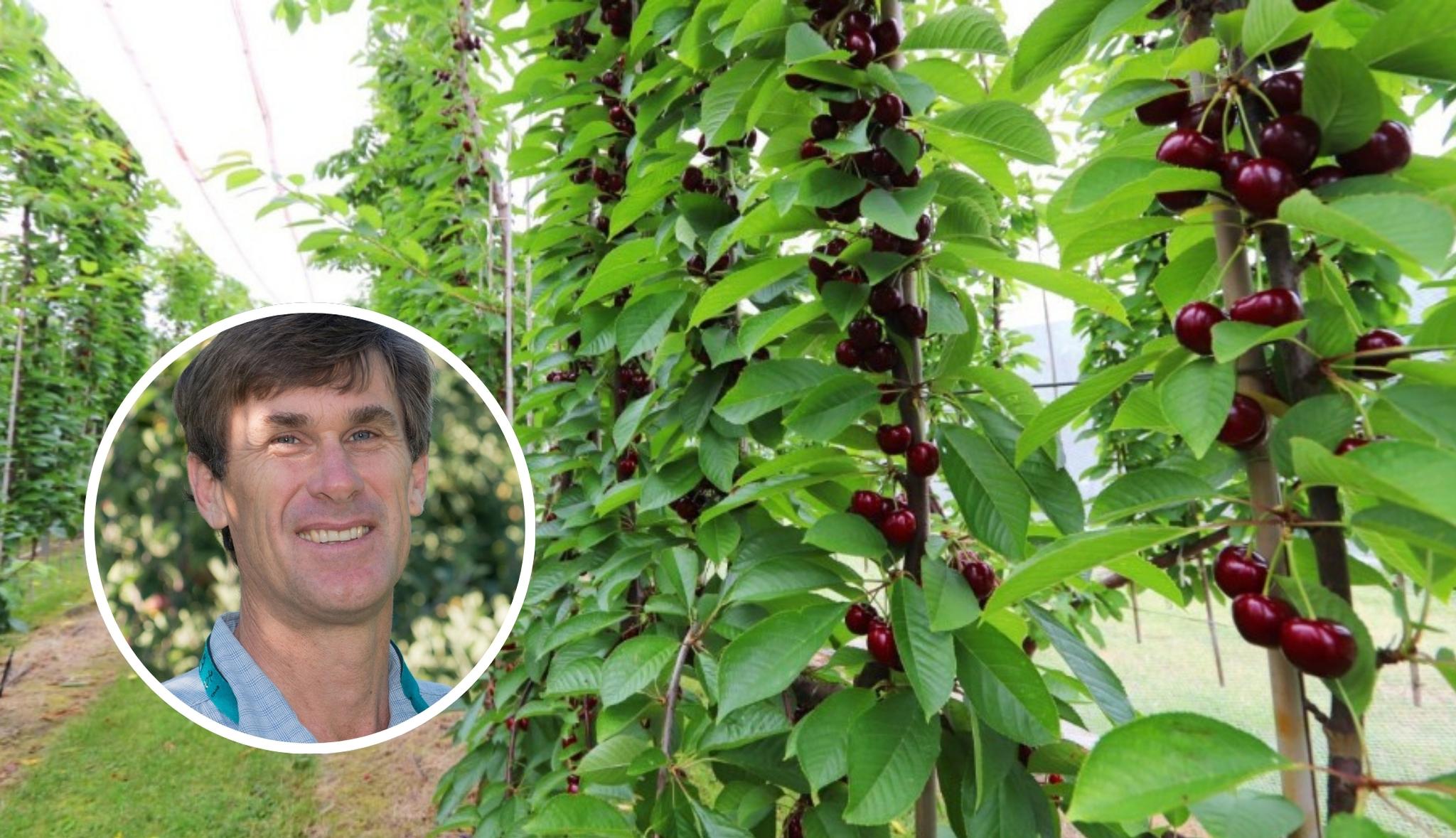
New Zealand Bioeconomy Science Institute principal scientist Dr Ken Breen (inset) says cherries (main picture) are leading the transformation of orchards into narrower, intensive fruiting walls. Pictures supplied
The days of stonefruit trees pruned in the traditional vase shape are numbered as Australian and New Zealand growers transform their orchards into narrower, intensive "fruiting walls" to boost light use, lift yields and prepare for robotics.
New Zealand Bioeconomy Science Institute principal scientist Dr Ken Breen, who spoke at last month's Summerfruit Australia national conference, said intensification was being driven by the search for "efficiencies", from higher yields of packable fruit to better use of fertiliser, irrigation, pickers and machinery.
Dr Breen said apple orchards had shifted over the past century from fewer than 100 standard trees per hectare with broad, 10-metre crowns to high-density hedgerows and spindles at up to 4000 trees per hectare.
Experimental planar cordon systems of 1700 trees per hectare had yielded more than 150 tonnes of apples per hectare in some NZ trials.
Dr Breen said similar two-dimensional structures were being tested in cherries and apricots at Clyde in the Central Otago region of NZ, and in Australian projects under Hort Innovation's Narrow Orchard Systems program.
The trials were based on the principle that "yield equals orchard light interception plus canopy light penetration".
Narrow, well-managed canopies increase the volume of productive foliage and improve uniformity of flowering and fruit quality.
Planar apricot trials showed narrow rows can match or beat centre-leader systems for yield per hectare at similar crop loads, while smoothing out differences in size and brix through the canopy.
But Dr Breen said pushing trees closer together was not without risk.
In planar sweet cherry trials, daily light at the bottom of the canopy fell by more than 80 per cent in 1.5m rows compared with the top, and was only about a quarter of that measured at the same height in 2m rows.
Dr Breen said this indicated 1.5m was probably below the limit for adequate flower initiation.
"And 2m may be as close as we can get," he said.
Growers also were wary of the capital cost of putting in more trees, posts and wire.
But Dr Breen said research under way into the return on investment from long-term trials producing apples, cherries and apricots on two-dimensional systems showed promise.
While adoption of fully automated picking and pruning remained at "functionally zero" in NZ, he said intensification and planar canopies would make operations easier for future robots.
"Robots struggle with 3D trees but they're pretty happy with a two-dimensional system, whether it's a horizontal canopy like a kiwifruit canopy, or a vertical canopy like a greenhouse tomato or an apple or cherry," he said.
"It makes life a lot easier for a robot if it's presented in a linear fashion."
Dr Breen said he expected adoption of semi-autonomous sprayers and sensing vehicles to take off as availability of seasonal labour tightened and the cost of ag-tech fell.
As well as sessions on new season export protocols, the retail code, farm automation, pollination and biosecurity, the conference included guided tours of the Steritech irradiation facility at Mickleham and finished with a networking dinner.
Summerfruit Australia industry development manager Jess Byrne said almost 100 delegates travelled from across Victoria, NSW and Western Australia to attend.
Ms Byrne said many growers reported 2025-2026 had been their best season in years for fruit quality and taste.
"It was a bit later than the previous season, which I think gave the fruit some time to really develop that really good summer fruit taste," she said.
"We were fortunate that the bulk of the season was completed before the fuel price issues arose, so we've not felt the impacts of that yet, directly."
This article appeared in Good Fruit & Vegetables magazine
