

Prevention, not paperwork, the driver of fresh food safety culture: grower
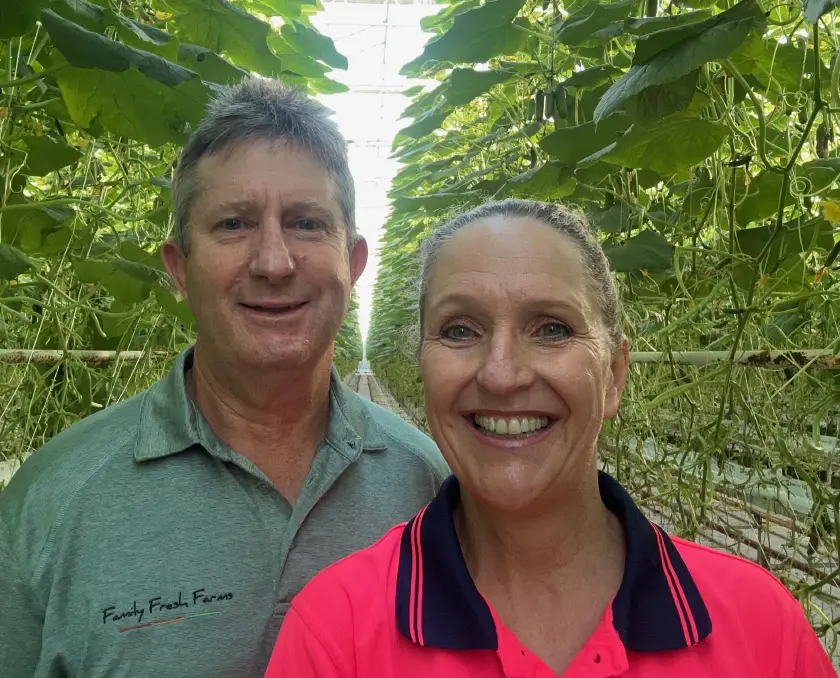
Family Fresh Farms senior grower Wade Mann and labour manager Nicky Mann. Pictures supplied
Former rose and berry grower turned cucumber producer Wade Mann has built a food safety culture at Family Fresh Farms that starts with the basics.
It's an approach driven by prevention, not paperwork, which he described in a presentation to the International Fresh Produce Safety Symposium in Sydney in July, and during a pre-event visit by delegates to the Peats Ridge glasshouses where he works.
From roses to Qukes
Mr Mann and his wife Nicky began their farming careers in Zimbabwe as cut flower rose growers, exporting into the Dutch flower auctions while the rest of the family produced tobacco, broadacre crops and cattle.
Political unrest and land appropriation pushed them to leave in 2002, with three young children and "literally, the clothes on our back and a few other bits and bobs in our back pocket".
Australia offered a new start for the couple who settled on the NSW Central Coast, leased land and grew roses for the domestic market.
Under pressure from cheaper flower imports out of Africa and South America, they diversified into berries, supplying Perfection Fresh, and entered the world of Freshcare, HACCP and third-party audits.
Mr Mann joined Family Fresh Farms at Peats Ridge as a grower in 2018, just as the second crop of Qukes baby cucumbers was going in.
At the same time, Mrs Mann was appointed labour manager responsible for the recruitment, training and pastoral care of the largely Pacific Island workforce.
Today, the business operates two 2.5 hectare high-tech glasshouses hydroponically growing snacking cucumbers for the domestic market, and employs about 80 staff across production and packing.
Specifications are tight. To pass muster Qukes must be 75mm to 115mm long, 16mm to 30mm in diameter and weigh 25g to 40g each. They are supplied in 250g punnets to Aldi, Coles, Costco and Woolworths.
Family Fresh Farms grows four crops a year, each across 12 weeks, and accounts for up to 30 per cent of Australia's snacking cucumbers. Perfection Fresh produces the rest at its mammoth 43ha glasshouse facility at Two Wells in South Australia.

Family Fresh Farms operates two 2.5 hectare high-tech glasshouses hydroponically growing snacking cucumbers at Peats Ridge, NSW.
Culture before checklists
Mr Mann's first formal exposure to food safety came with berries, where Freshcare accreditation and HACCP training were mandatory for supplying Perfection Fresh.
At Family Fresh Farms, he stepped up when the previous food safety officer left, describing it as "a bit of a baptism of fire" in a much slicker operation, with more volume and more pain points.
To build his knowledge and keep in touch with emerging issues, he volunteered on the HARPS Technical Advisory Group and engaged closely with the Fresh Produce Safety Centre's seminars and webinars.
That exposure cemented his view that food safety had to be driven by culture, not fear of audits.
During harvest it was important for biosecurity purposes to guard the crop against potential outbreaks of virus, fungal and bacterial disease, and pests.
"The double-up there is if you're taking care of that, you're taking care of the produce as well from a food safety aspect," he said.
"It goes far beyond a tick-and-flick exercise. Prevention is better than control. We want to be proactive before we have to become reactive."
Mr Mann is also realistic about the practicalities of running a commercial glasshouse.
"We want to be perfectionists, but we certainly are not pretending that we don't have challenges and have problems," he said.
Rather than hiding those issues, he shared "warts and all" examples during the site visit so growers could see how theory translated into day-to-day decisions.

Pacific Australia Labour Mobility scheme workers pick Qukes baby cucumbers at Family Fresh Farms.
Bringing workers along
A cornerstone of Family Fresh Farms' food safety program is its induction and support for seasonal workers, recruited from Vanuatu under the Pacific Australia Labour Mobility (PALM) scheme.
Mr Mann said the starting point was recognising many recruits came from villages without access to reticulated water or toilets, so concepts Australians took for granted must be carefully explained and demonstrated.
"We need to basically impress upon them the importance of personal hygiene," he said.
"That includes having a shower every day, wearing a clean uniform, making sure they wash their hands properly, making sure they know how to use the toilet."
On-farm accommodation is fitted out with hot showers, toilets and soap, and workers receive freshly-laundered uniforms each day to make those expectations achievable.
New arrivals are paired with returning workers in a buddy system designed to make it easier to ask questions and avoid embarrassment about unfamiliar facilities or practices.
The same approach carries over to the glasshouse and packing shed, where experienced staff show newcomers how to harvest and pack within specifications, wearing hair nets, beard nets, gloves and using other controls to prevent physical contamination.

Pacific Australia Labour Mobility scheme workers sort and pack Qukes baby cucumbers at Family Fresh Farms.
Training in two languages
The Manns invest heavily in visual and bilingual training to reinforce the basics and maintain standards over time.
Every time a cohort returns from Vanuatu, they complete a refresher program.
This includes videos with live commentary in English and Bislama, backed up by posters - some deliberately graphic - showing what can go wrong if cuts, sneezes or poor hygiene aren't properly managed.
"By filming, by having commentary in both languages, it really gives these guys a sense of purpose, a sense of our beliefs, our values, a sense that we are willing to ensure that they are fully embraced," he said.
For smaller enterprises feeling crushed by compliance, Mr Mann acknowledged the burden of one person wearing every hat - as grower, picker, packer and quality assurance manager.
But he argued getting the fundamentals right up front made everything else easier.
"Regardless of whether you're a smaller operation or a big operation, if you can try and fine-tune it from the beginning - personal hygiene, sanitation, product quality and so on - generally speaking, the flow is quite easy," he said.
"It's when you're not following certain protocols, or you're not giving attention in the right areas, those negatives can start to manifest and build up, and then it becomes a real drama at the end, trying to clean up the product or clean up your machinery."
This article appeared in Good Fruit & Vegetables.
