

Reading the trees: Alessio Scalisi charts a data-driven course to better fruit
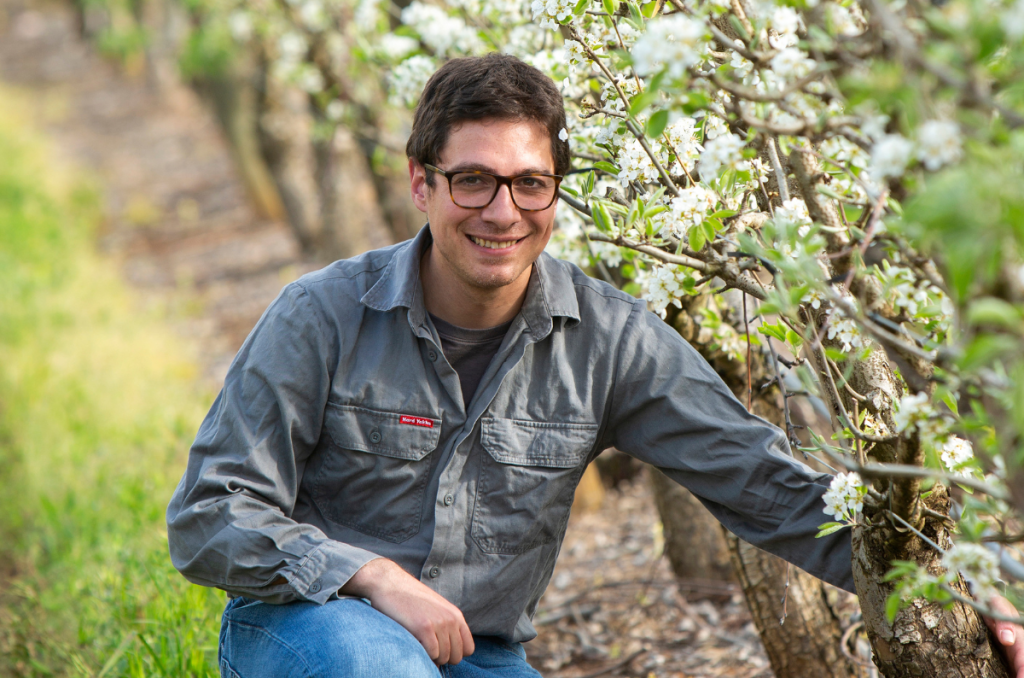
Research & Extension Provider of the Year 2026, Alessio Scalisi, Agriculture Victoria. Photo: Liz Arcus
Less than a decade since he first came to Australia, Italian-born
researcher Alessio Scalisi has already made his mark on the way apple
orchards are managed in the Goulburn Valley and beyond.
This year’s Research & Extension Provider of the Year, Dr Alessio Scalisi, is a senior research scientist at Agriculture Victoria’s Tatura SmartFarm, where he is developing smart tools to help pome fruit growers achieve the best yield and quality standards.
After growing up in Sicily, Alessio was completing his PhD at the University of Palermo and looking for a way to squeeze an extra summer season into his research year.
The Southern Hemisphere beckoned and a contact at Agriculture Victoria helped open the door to work on stonefruit and olives with Dr Mark O’Connell at Tatura in 2017.
“I went back home, I finished the PhD, and then I decided to come back to Australia,” Alessio said.
After a stint as a casual, Alessio was employed as a senior technical officer on the PIPS 3 (apple and pear industry’s Productivity, Irrigation, Pests and Soils) program, working with a mobile sensing platform that scans trees and produces detailed maps of blossoms, fruit, canopies and tree size.
Today, Alessio is a senior research scientist, working closely with
research leader Dr Ian Goodwin on the flagship PIPS 4 Profit and Narrow
Orchard Systems projects.
He lives in nearby Kyabram with his Australian wife, Madeleine Peavey – herself an apple and pear researcher and PhD candidate – and their two young daughters.
Alessio describes himself as ‘a hybrid’ after becoming an Australian citizen in 2023 and regards the region as home.
Much of his work sits under the banner of precision horticulture – building and validating tools to help growers manage orchards more accurately and profitably.
Instead of blanket sprays or one-size-fits-all thinning, Alessio’s research focuses on using orchard data collected by a mobile scanner to map spatial variability and drive variable-rate applications and more targeted management.
By understanding where trees were under- or over-loaded, he said growers could act early to reduce variation in fruit size and colour, and present more uniform, premium fruit to market.
It is painstaking work, but the mobile scanner has reduced the time and people needed to collect data, allowing much larger trials and improved economic considerations in the PIPS 4 Profit program.
Alongside sensing and mapping, Alessio is involved in trials on new orchard training systems, including the Narrow Orchard Systems project which is funded by Hort Innovation Frontiers.
These systems aim to bring canopies closer, improve access for people, machines and robots, and lift yields and quality by making it easier to properly manage every tree.
He is also helping steer work on deficit irrigation strategies for apples, combining different crop loads with carefully timed water stress to cope with drought years – which are likely to intensify under climate change – without sacrificing too much yield or quality.
The nomination for the Research & Extension Provider of the Year award described Alessio as a lead researcher in the apple industry, recognising his role in convening conferences and supporting events such as the APAL Technical Forum.
It also highlighted his readiness to collaborate, supervise students from Australia and overseas, and champion good, industry-relevant science.
When Alessio learned he had been nominated, his first reaction was surprise.
“I was not expecting it, for sure. And that’s because, to be honest, I haven’t been around that long,” he said. “I see our work as teamwork rather than a personal thing, but I’m really happy; I’m really grateful to the industry.”
Alessio said he appreciated the close connections and collaboration with Australian growers and industry.
“They’re constantly, in a way, shaping what we do,” he said. “They actually help us stay on track with industry needs, rather than doing our own bit of research that is not driven by what the growers need.”
This article was published in AFG magazine and on the APAL website.
