

Researcher champions ‘free pest control’ for growers
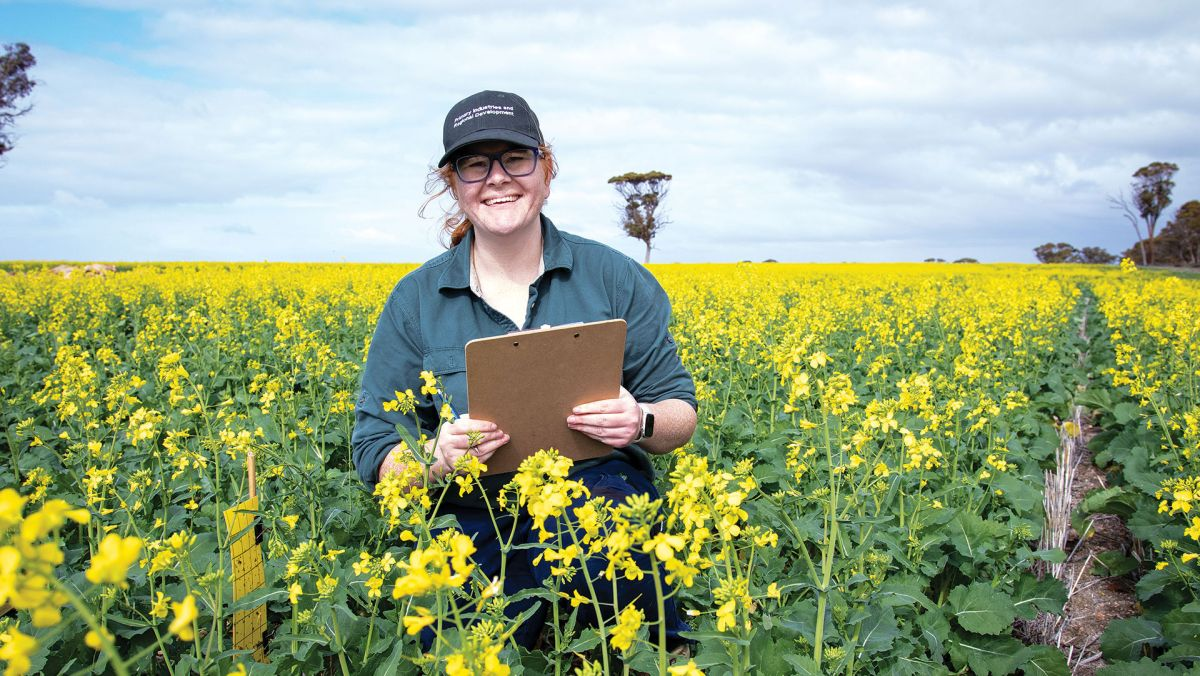
Researcher Amber Balfour-Cunningham surveys pest and beneficial insects in a canola field at Cunderdin, WA, in July 2024. Photos supplied
Researcher Amber Balfour-Cunningham is on a mission to help Western Australian grain growers make the most of the ‘free’ pest control already available in their paddocks – tiny parasitoid wasps and other beneficial insects that attack diamondback moth in canola.
The first detailed picture of the natural enemies of crop pests in WA farming systems is being developed in research at the University of Western Australia (UWA) to better support the use of ‘free’ control strategies. Supported by a GRDC Research Scholarship, researcher Amber Balfour-Cunningham is establishing guidelines for growers and advisers to monitor, protect and harness natural insect allies.
Ms Balfour-Cunningham’s interest in nature, and especially entomology, was inspired by her father Tony Cunningham’s work as a forestry consultant. She went on to study biochemistry and molecular biology at UWA, graduating with first-class honours before heading into applied agricultural research.
Ms Balfour-Cunningham has worked on Mediterranean fruit fly and other horticultural pests at Carnavon, a centre for vegetables and tropical fruits production. Since moving into grains entomology at Northam, she has “caught the bug” to research insects in biological control and crop protection.

A beneficial parasitoid wasp, Diadegma semiclausum, lays eggs in diamondback moth larva on a canola leaf in a controlled glasshouse study at DPIRD Northam in June 2025.
Why diamondback moth?
Ms Balfour-Cunningham worked on a 5-year GRDC project surveying diamondback moth (DBM) in canola, which concentrated mainly on the pest itself and how it behaved in WA farming systems.
During that project, she says she kept noticing beneficial insects in DBM-affected paddocks, but their role was outside the project scope – prompting the idea for her PhD.
Recognised as the world’s most widespread pest insect and highly insecticide-resistant, DBM can cause yield losses of more than 80% when populations explode in flowering canola.
Climate projections for the WA grainbelt point to warmer, drier conditions between now and 2050, which are expected to increase the frequency of DBM activity and outbreaks.
"It can build up numbers
quite quickly and is a bit better understood in some other countries –
for example, in Canada, where it migrates from Mexico,"
Ms Balfour-Cunningham says.
Research has improved the knowledge in Australia, but there are still questions about the role of beneficial insects.

Researcher Amber Balfour-Cunningham studies samples of beneficial parasitoid wasps, Diadegma semiclausum, in the University of Western Australia lab in July 2023.
Tracking tiny wasps
As part of her PhD, Ms Balfour-Cunningham is investigating natural enemies of DBM, especially larval parasitoid wasps, at both paddock and regional scales, and testing practical monitoring tools for growers and agronomists.
From 2022 to 2024, she surveyed 20 to 40 grower-managed paddocks across multiple zones, as well as dedicated insecticide-free research crops and glasshouse trials at Northam.
In 2022 and 2023, DBM parasitoids were only detected in the Albany port zone, leading Ms Balfour-Cunningham to wonder if these beneficials were largely absent from many canola regions.
During 2024, high DBM pressure was noted across much of the grainbelt, and multiple species – including Cotesia spp. and Diadegma spp. – were documented in other zones.
In the Esperance zone, which recorded the highest DBM numbers in more than a decade, 4 parasitoid species were found.
Despite growers commonly complaining that beneficial insects usually arrived too late to prevent crop damage, Ms Balfour-Cunningham says this was not the case for these tiny, black wasps, which can be present well before DBM reaches damaging levels.
“I found at some sites...when the pest was first detected, beneficials were also there,” she says.
“They’re small and they move around, so they’re difficult to see; so you can actually have them without realising.”
In an unsprayed canola paddock at Dalyup, near Esperance, sampling in mid-July 2024 found 33 to 65% of DBM larvae were parasitised when the crop was at the rosette stage, even though pest numbers were still below damaging levels.

A beneficial parasitoid wasp, Diadegma semiclausum, on the flower of a potted canola plant at DPIRD Northam in May 2025.
Paddock patterns
Ms Balfour-Cunningham’s spatial sampling work reveals how plant health, landscape features and spray decisions influence both pests and natural enemies.
In a 1 ha paddock near Cunderdin, DBM hotspots aligned with areas of poorer soil quality, lower biomass and reduced yield, supporting the idea that patches of stressed crop were more attractive and vulnerable to attack.
She also found:
- hotspots for predators, including ladybird larvae, showed moderate spatial alignment with DBM larvae, suggesting predators were responding to pest populations
- parasitoid wasps were more commonly detected near crop edges, possibly influenced by remnant vegetation or other non-crop habitats, although their spatial relationship with DBM was less straightforward
- these patterns support more targeted monitoring – especially in stressed patches and along paddock edges – and open the door to spot or precision spraying where insecticides are still needed.
Along with sweep nets and yellow sticky traps, Ms Balfour-Cunningham tested novel traps and practical field methods to detect parasitoid activity.
With in-kind support from WA Department of Primary Industries and Regional Development, research continues at the Northam glasshouses to quantify biological control ratios: how many wasps are needed relative to DBM.
Capacity building
Ms Balfour-Cunningham’s GRDC Research Scholarship underpins both her research and her development as a grains entomologist and science communicator.
The scholarship has helped fund field surveys across the WA grainbelt, glasshouse trials and attendance at national and international events, including the GRDC Grains Research Updates in Perth and regional WA and Royal Entomological Society online conferences.
She has used these opportunities to share WA grains integrated pest management stories and learn from experts in Canadian canola and Australian cotton, strengthening links between all broadacre industries grappling with how to better harness natural enemies.
Through field days, updates and social media, her presentations on DBM and beneficials have been singled out by growers as highlights. More than 70% of participants at one event planned to investigate beneficial friendly management options as a result.
Ultimately, Ms Balfour-Cunningham wants growers, advisers and input suppliers to factor beneficials into their pest management decisions as routinely as they look at thresholds and spray labels. She is working with growers to understand why they spray – or choose not to spray – and how natural enemies fit into their economic and environmental goals.
By 2026-27, as she completes her PhD, Ms Balfour-Cunningham aims to deliver regionally relevant guidelines on where and when parasitoids are likely to occur, which monitoring tools work best, and how growers can protect these natural allies.
This article appeared in GroundCover
