

Rising to challenging season
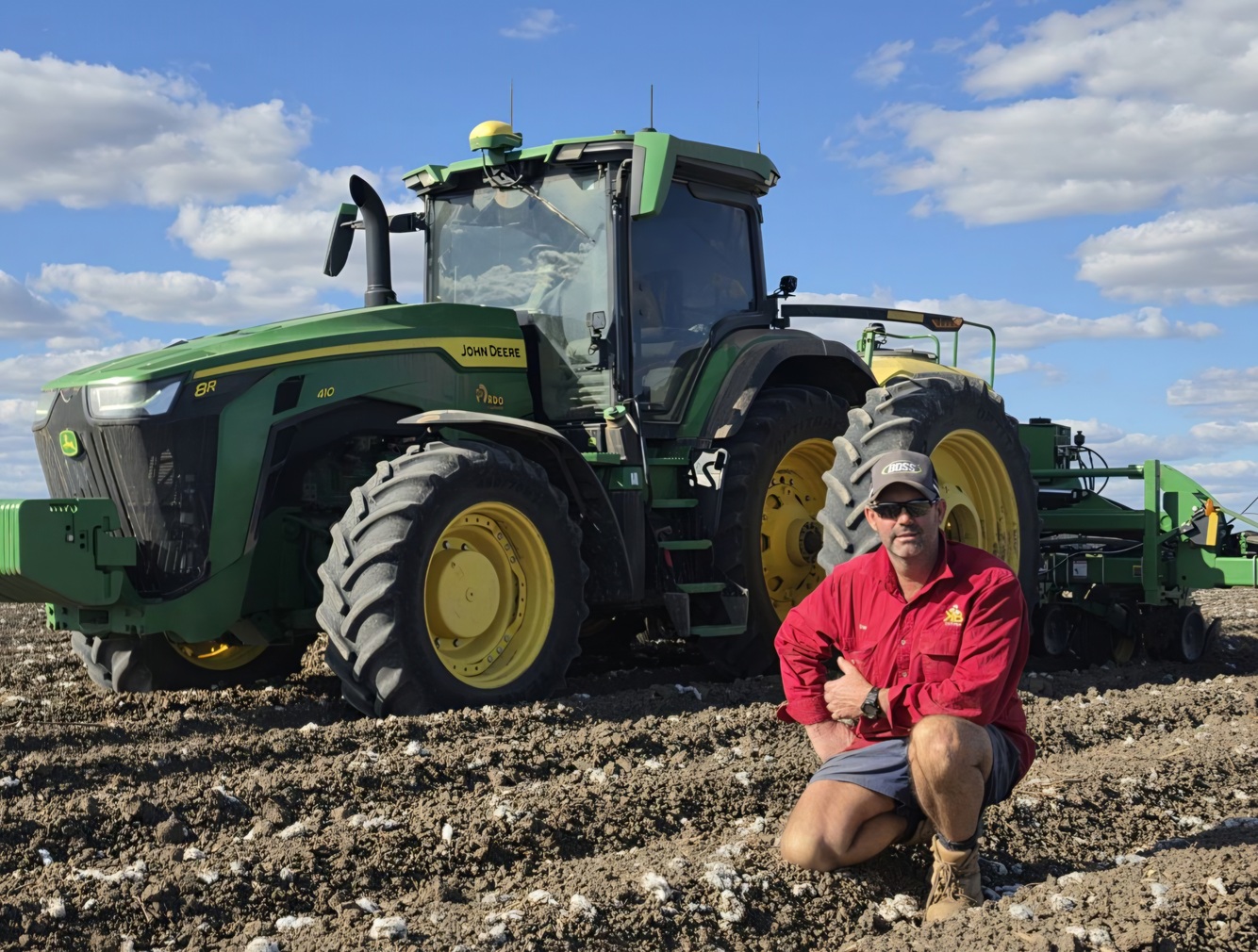
Theodore cotton grower Dan Austin begins planting the next cotton crop at Kooroowatha, Qld. Picture supplied
With the chickpea crop looking a picture and hopes for a solid opening water allocation, third-generation Dawson Valley cotton grower Dan Austin is optimistic about the coming season.
Mr Austin, wife Rachael, and their eldest son Rhett farm 1350 hectares at Kooroowatha, south-west of Theodore.
Under the KB Cotton banner, they grow summer crops of cotton and occasionally mungbeans, and winter crops of wheat and chickpeas.
About 700ha of Kooroowatha is set up with flood irrigation, and another 170ha is suited to dryland cropping.
The rest is pasture where another farmer has stock on agistment until the Austins are ready to get back into cattle.
The cotton is usually grown back-to-back, with the occasional cash crop of chickpeas in between, including 120ha sown in May.
"We didn't have a very good cotton crop, so they're an opportunity crop to try and get a bit of cashflow in between cotton seasons," he said.
"They're looking really good at the moment."
Mr Austin said the farm average yield for the 2025-26 cotton crop was about 10 bales a hectare, compared with the long-term average of 12 bales for grown on crops.
"We had a fair bit of weather damage in January, and then again in late March," he said.
"We get a coastal influence here, and we got a couple of weeks of cloudy, humid weather, so it aborted a lot of fruit, and by the time it recovered from the (damage) in January, the next lot hit, and it aborted all that fruit as well.
"We probably only had eight bales on it in February, so we didn't have a lot of choice. We had to grow it on to get a half decent yield off it."
Mr Austin had planted the 600ha of Sicot 619B3XF, Siokra 253B3XF and some Sicot 746B3F in the last week of September - a month later than usual, because of cooler temperatures.
"It was a pretty good year for disease," he said.
The crop was treated twice for mirids, and Mr Austin said it had not been necessary to spray against silverleaf whitefly for quite a while.
The cotton was picked in May and modules sent to the Queensland Cotton gin at Moura.
Mr Austin said he had been "really happy" with the XtendFlex varieties to date and the coming crop would be entirely XtendFlex varieties: Siokra 253B3XF and Sicala 320B3XF.
He has yet to spray dicamba, but said having that option might be useful in future for controlling problem weeds such as bell vine, feathertop Rhodes grass and sesbania.
Preparation for the 680ha 2026-27 crop began with a Tilco side buster to break down and reform crop beds in a single pass, followed by application of 250kg/ha each of urea and monoammonium phosphate banded under the row.
Mr Austin said he then ran over the fields with a cultipacker and roller to crush clods and firm up the seedbed, before planting of 560ha started on August 22.
Using a 12m John Deere ExactEmerge planter, the cotton was planted at 14 seeds to the metre on one metre row spacings.
Mr Austin has bought a nose tank for his tractor so the crop can be side-dressed with urea at 250kg/ha just before it reaches the first flower stage.
"We'll side-dress with our cultivator this year," he said.
"We had a few dramas with nutrition last year because of the spreader."
Another 120ha will be planted to cotton after the chickpeas are harvested.
Under ideal conditions, the Austins would start desiccating late February - later if the crop needs to be grown on - with picking to begin in March.
The current crop is due for its first irrigation in mid-October.
During the past seven years, Kooroowatha has been converted from siphons over the bank to through the bank siphons which now water more than 90pc of the irrigated area.
Mr Austin said the major benefit from the switch had been ease of operation.
"We've gone from three or four of us irrigating down to ... I can just do it by myself pretty much, that's the biggest thing," he said.
Water is sourced from the Dawson River via the Theodore Channel Irrigation System and stored on-farm in five ring tanks with a total capacity of 2500 megalitres.
Mr Austin budgets on eight to 10 megalitres a hectare for the cotton, which is enough to top up average annual rainfall of 620mm.
With multiple soil types - as many as five in a single field - he uses a combination of moisture probes and personal experience to guide irrigation scheduling.
"We've got a fair bit of loamy country here that can use a bit more in a hot year," he said.
"It dries out a lot quicker so you've got a five-day turnaround in that compared to 10 days for some of the heavier country."
Since 2023, Mr Austin has used drones for spraying weeds and applying insecticides and desiccant when the fields are too wet to use a ground rig.
He recently signed up with DataFarming and plans to use Normalised Difference Vegetation Index (NDVI) mapping - which measures light reflection as a proxy for plant health, vigour and density - to guide variable rate spraying, especially with pix sprays for managing vegetative growth during the season.
One of the things Mr Austin said he had enjoyed most about growing cotton since returning to the farm in 1997 was the constant innovation in the sector.
"Australia is really good at that," he said.
This article appeared in Australian Cotton & Grains Outlook.
