

Robots, ripping, revised rotations: a reset for the future
A deliberate ‘gap year’ in 2023 has helped Western Australian grower Brady Green steady his farm business after damage from Cyclone Seroja.
He’s moved to SwarmFarm robotics and is revising traditional wheat/canola/wheat/lupin rotations to test higher-value lentils.
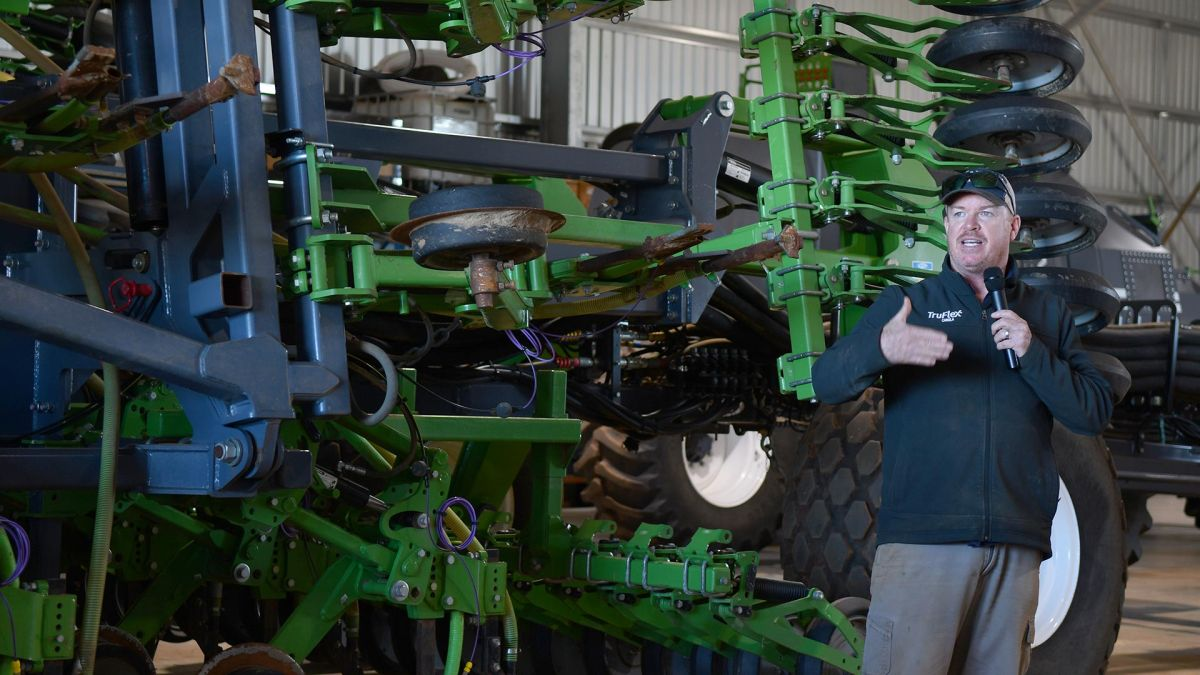
Brady Green shares his experience of soil amelioration in wheat/canola/wheat/lupin rotations to see where lentils may fit in. Photo: Melissa Marino
Christmas 2025 came early for WA grower Brady Green with the arrival
in November of a SwarmFarm robot, which has been christened Raymond 2.0.
“It’s super exciting,” he says. “I haven’t been excited about a machinery purchase like that for some time.”
The plan is for the machine to tow a 24.4 m Weed-It and trundle along behind the headers to spray summer weeds as soon as crops are harvested.
This will eliminate the expense of spraying contractors, reduce chemical use and allow the team to wrap up the season before the year’s end.
“It seems to be the most demoralising thing to do, to finish the harvest – when we’re all exhausted – and then get straight on the sprayers to spray the whole farm when we’re knocking on Christmas’s door,” he says.
It’s also a step towards preparing the farm to be ‘autonomous ready’ by mapping paddock boundaries.
“I feel like once we start to use the technology, we’ll continue to think of jobs that it can do,” he says.
Brady and his wife, Erin, along with daughters Madi and Holly, farm 10,000 ha at ‘Carrawingee’ and ‘Waterloo’, north-east of Geraldton, in Western Australia’s mid-west region, as well as ‘Rusty’s’, which they share farm with 2 workers.
They quit livestock in 2007 to focus on continuous cropping, and they produce wheat, canola, lupins and lentils.
Victorian grower and consultant Robert Ruwoldt helped the Greens establish a 12.2 m controlled-traffic farming system in 2008. He also spent a decade advising the family as a member of their farming business board set up in 2009.
Soil amelioration
Soil improvement underpins much of the recent yield growth on the farm, mainly in wheat and canola. Approximately 70% of the country is yellow sandplain and 30% red loam, with a long-term liming program aimed at lifting pH to at least 6 throughout the top 500 mm.
Brady says they ramped up lime application to 6 t/ha on sandplain areas intended for amelioration over 6 years, before starting spading in 2017.
Spading cost about $66/ha and was rolled out across approximately 2,500 ha a year for 2 years, using smaller gear that suited the existing machinery fleet and labour.
Brady says summer rainfall patterns made spading more attractive than mouldboard ploughing because it could start earlier and did not require another full crew and large tractor at a time when the focus should be on seeding.
“Our 6-year average yield in 2013 for cereals was 2.4 t/ha and this year – which is going to be our highest cereal production season on record – is probably going to be over 3.5 t/ha,” he says.
“That’s a combination of some pretty good seasons, but it’s largely on the back of amelioration that pushed us for the 30% yield gains.”
Taking a gap year
It hasn’t all been plain sailing, however, with Cyclone Seroja crossing the coast just north of Geraldton as a Category 3 severe tropical cyclone packing winds of up to 150 km/h in April 2021.
“That was the first cyclone that’s impacted us as a family farming unit, and it was very destructive,” Brady says.
The cyclone wiped out two 1,100 t silos and 3 sheds – including the workshop, staff accommodation and a fertiliser shed – although it didn’t bring only bad news: growing season rainfall amounted to more than 400 mm and ultimately led to a “very profitable year”.
But after 2 big seasons, with input costs rising and plans to replace and expand infrastructure, Brady says they were ready for a “gap year” by 2023.
“We had a late break, high input costs and we could see our top-end potential yields dropping, and there was a lot of fatigue within staff and ourselves,” he says.
“So we decided to only put half of the farm in and just had a steady season. It paid dividends because it wasn’t a great year...lupins were poor that year, so I’m glad we didn’t plant any.
“The cereals were okay, but we got to have a good look at our paddocks and see a few weed issues looming. It was a bit of a reset year for us.”
Revising rotations
The aim is to run with a wheat/canola/wheat/lupin rotation on most soil types, while testing where lentils might fit.
Brady says lentils caught his attention over years of hosting trials for Yuna Farm Improvement Group and the Western Australian Department of Primary Industries and Regional Development.
“We first had lentils here in 2023 and 2024, and they were the highest-performing pulse in a long-term pulse trial,” he says.
“In 2023 they did particularly well. Even though it was a very dry season, they still did 1.5 t/ha. We’re looking for a legume that we can grow profitably on our heavier soil types, because lupins don’t seem to do very well.”
Lupins have been a mainstay of the rotation, but Brady says they are no longer profitable enough and a higher-value pulse option is needed to help offset high input costs.
He says growing lentils was quite different both agronomically and logistically.
In 2025, he planted 40 ha of lentils into 2 different soil types, with yields averaging about 1.2 t/ha on heavier soils and about 2.3 t/ha on sandplain.
CBH Group also took lentils into Kwinana’s Metro Grain Centre for the first time in 2025. However, Brady expects growers will need to invest in on-farm storage to manage timing and market access.
“I think people will experiment with lentils in the next few years [but] they need to prove their worth before they’re widely adopted,” he says.
This article appeared in GroundCover
