

Smart vineyard digital twins offer new weapon against disease
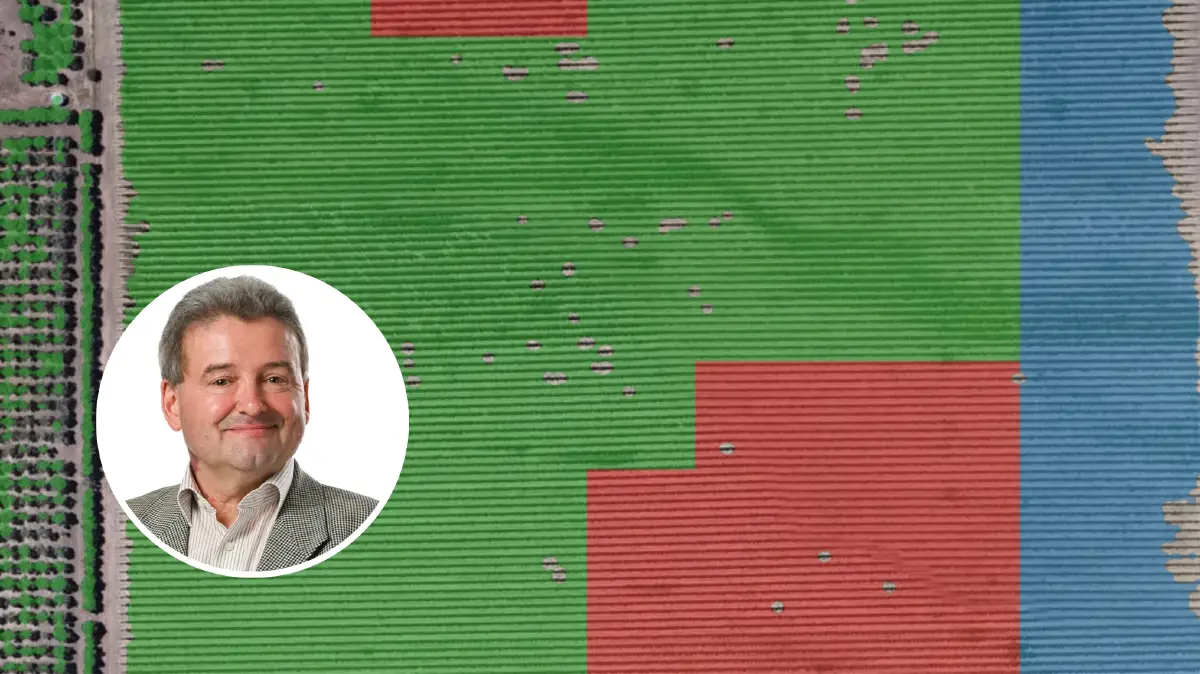
A map of the grape block at Serafino Wines showing areas of healthy vine in green, leaf blight disease in blue and black rot in red, and (inset) Adelaide University Professor Volker Hessel. Pictures supplied
Adelaide University researchers are using vineyard trials at Serafino Wines in McLaren Vale to turn digital twin theory into practical disease management tools for winegrape growers.
The big three diseases - powdery mildew, downy mildew and Botrytis bunch rot - cost the Australian wine industry up to $300 million each year.
The project aims to give growers AI-driven "virtual experts" that help them make quicker, better decisions about vine health, improve the timing and accuracy of fungicide sprays, cut chemical use and pollution, and reduce losses from disease.
The work grew out of space research, where Professor Volker Hessel and colleagues first developed digital twins to understand how plants grow in tightly controlled environments.
It's not the first innovation to come from space: global positioning systems (GPS) developed by the US military have become mainstream in agriculture since 2000.
During the 2025 growing season - from September to December - Prof Hessel's team moved from desktop models into a 25 hectare block of shiraz, cabernet sauvignon and merlot wine grapes at Serafino Wines, flying drones to collect and interpret vegetation indices.
"Number one, we learned how to sense data with drones on our own for a whole vineyard," he said.
"Number two, what we learned is to use those data and to predict vine diseases."
Using canopy-weighted false-colour maps and deep-learning models, they generated disease-risk maps for powdery mildew, downy mildew and Botrytis.
Crucially, the team pushed beyond simply flagging whether disease was present to estimating how bad it was likely to get and adapting algorithms so they could recommend if and when to spray.
That information was fed into a governance-flow tool co-developed with XMPro, where multiple AI "agents" weighed up disease risk, spray rules and regulations to generate both a detailed technical report and a one-page snapshot for growers.
The prototype tool, dubbed VineDoc, automatically calculated the CO2 footprint of fungicide use and checked spray decisions against withholding periods and other rules.
Prof Hessel said the season at Serafino Wines yielded useful, but not extreme disease pressure, with an early rise in infections followed by a lower second progression.
The field work will be extended to cover a second season this year, which he said would be vital for building experience under different conditions.
Digital twins have already been proven in the mining and automotive industries, but Prof Hessel acknowledged they were still in their infancy in agriculture where cost, simplicity and fit with growers' routines would determine uptake.
Serafino Wines vineyard manager Andrew Godfrey said other challenges for implementing digital twins included the need for site-specific hardware such as weather stations, drones and cameras, as well as reliable internet access.
Mr Godfrey said the extra costs would be difficult for many wine grape producers to justify "with the industry being pretty much on its knees" and an unpromising global outlook.
"There's definitely benefits to it, but there's also the issue of trust," he said.
"I have an irrigation system that's a radio link style system and when the internet goes down, I'm totally locked out.
"If you're relying on it, it could be an issue when things go dark and if you can't just go out and turn switches on and off, you know you are in trouble."
Prof Hessel said commercial-ready vineyard tools could become available in the next three years.
WHAT IS A DIGITAL TWIN?
In this case, a digital twin is a virtual version of the vineyard that is continuously updated using real-time data from sensors, drones and other monitoring tools.
Drone images are used to create maps using artificial colours and colour intensity that highlight differences in growth and vigour, helping to spot problem areas and disease risk early.
Software then pulls this information together and uses artificial intelligence to predict issues, test "what-if" scenarios and suggest practical actions, such as when and where to spray.
This article appeared in Good Fruit & Vegetables magazine.
