

Tight margins continue
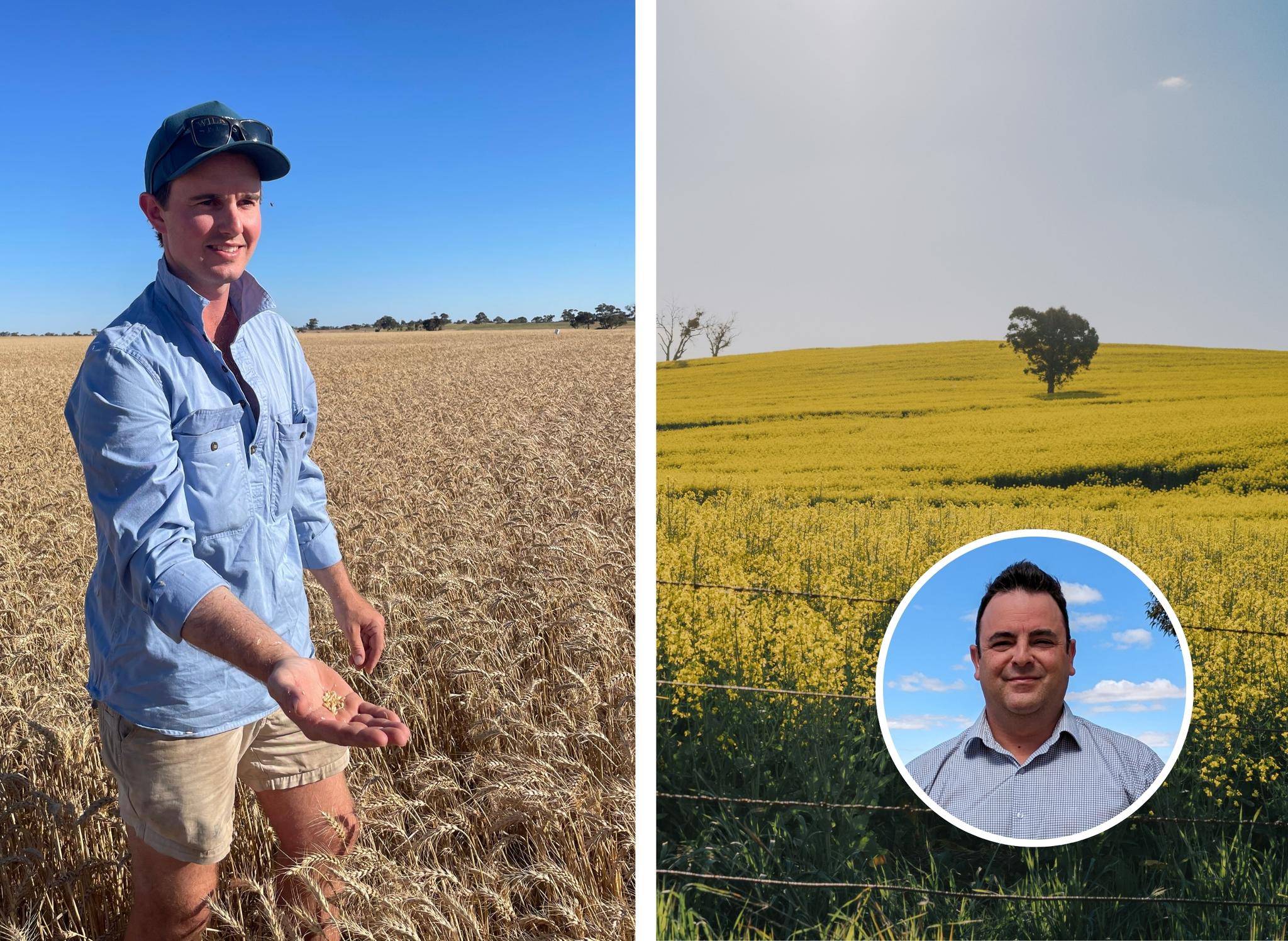
Keith mixed farmer Jeremy Lush (left) and Grain Producers SA chief executive Brad Perry (inset). Pictures supplied
South Australian grain growers are looking at one of their best starts in years, but their optimism has been tempered by some of the tightest margins ever thanks to stubbornly high input costs.
Grain Producers SA chief executive Brad Perry said grower confidence had risen markedly after two of the driest years on record in South Australia.
"It's been certainly uplifting in the mood and confidence to have all this rain, and most growers are saying it's the best start that we've had in years," he said.
"I've just been up on the Eyre Peninsula and Yorke Peninsula, and crops are really tracking along well."
In its most recent crop and pasture report, the Department of Primary Industries and Regions (PIRSA) also highlighted the role of good early rainfall, full soil moisture profiles in many districts and strong early crop growth, especially in the two main cereal crops: wheat and barley.
The report said the area planted to lentils was forecast to increase again, firmly establishing lentils as the third largest crop area behind wheat and barley.
EXCEPTIONAL START
At Keith in the state's South East, mixed farmer Jeremy Lush said the season had been "quite exceptional" to date.
By late July the properties he farms with his father Rodney had recorded about 270 millimetres of rain for the year. Average annual rainfall is 425-450mm.
Useful falls in February and March allowed them to start seeding in the third week of April and the 150 hectares of canola was in flower.
"It looks really good at the moment," Mr Lush said.
"The soil's damp and it's been mild, so things are growing probably ahead of where we would be normally.
"It's a sight for sore eyes after the last two years, 2024 and 2025, where it didn't really rain at all until the middle of June."
As well as wheat, barley and canola, the Lushes grow lucerne seed, and vetch and multispecies crops for grazing.
They also run a self-replacing flock of Merino ewes and first-cross ewes producing about 4000 prime lambs this year.
"There's really solid potential across everything, and it's really just a matter of what spring's going to give us by way of frost and rain," Mr Lush said.
Should the 300ha of barley experience frost damage, cutting it for hay remained an option, although Mr Lush said he would prefer to harvest the grain given the greater flexibility of marketing it.
They store about half the grain they produce on-farm for livestock feed and oversow lucerne with barley for hay or silage "depending on feed on offer, what the season's doing, time of year and the window we've got to make it".
"This year, the vetch was sowed in a mix with a few other things, and that's all gone berserk," he said.
"I can see us taking a silage cut off that just to make sure we utilise what we're growing, and then we'll hopefully get another graze behind that."
Helped along by the mild winter, he hoped the early flowering of canola would allow it to do most of its work while there was still moisture in the profile.
THE 'ELEPHANT IN THE ROOM'
Mr Lush said the climate outlook for the rest of the season was "the elephant in the room".
The Bureau of Meteorology last week declared an El Nino was underway and said it was likely to persist until at least summer.
While forecasts pointed towards a strong to very strong El Nino event, which could "peak at levels among the highest observed since 1950", the update carried the caveat that a strong El Nino did not necessarily mean strong impacts on Australia's climate.
Mr Lush said the outlook for drier than average and warmer than average conditions did not mean the season would automatically turn extremely hot and dry.
"It may still be that for us, but we may get the right amount of rain to finish the potential that we've got," he said.
"That's probably one thing that we've seen in the last couple of years - rain at the right time, even if it's not very much, is just as valuable as lots of rain, if not more so.
"We don't need much to get to the end; we just need something, and you'd hope we do get that."
Like most grain producers, Mr Lush is getting on with the job for now.
Having good paddock feed and crops off to a flying start was a welcome change but, after the past two years, he would still be closely watching the forecasts, he said.
GROWERS PUSH ON
Despite two bruising seasons, Mr Perry said most of the state's grain producers had pushed ahead with their seeding programs and, on average, increased the area under crop this year.
A GPSA Seeding and Seasonal Outlook survey of 384 growers found they planned to crop 366,000ha, 5 per cent more than last year.
Mr Perry said the survey showed wheat and barley were still the backbone of South Australian grain production, but the mix was changing.
The proportion of growers planting wheat fell from 92 per cent in 2025 to 87 per cent this year, while barley dropped from 87 to 84 per cent.
Lentils continued their steady rise, with 56 per cent of growers planting lentils in 2026, up from 49 per cent the previous year, and canola had "made a bit of a comeback" after being rotated out during the dry years.
Mr Perry said the area planted to lentils had grown year-on-year despite weather challenges, while canola growers had taken advantage of early moisture and crops in many areas were already flowering.
COSTS BITE
While the paddocks look promising, the GPSA survey showed sentiment was still fragile, with growers rating their confidence at an average of five out of 10 - up slightly from four last year, but far from buoyant.
Almost six in 10 respondents nominated input costs as their biggest worry at seeding, and 93 per cent said input costs or availability, coupled with lower grain prices, had raised questions about crop profitability.
The survey indicated growers were responding by changing agronomic decisions as well as tightening farm budgets.
More than 70pc had reduced fertiliser use compared with 50pc during the 2025 drought, and 28pc said they had changed crop types.
"Many grain producers told us they had either reduced crop area, adjusted rotations, reduced nitrogen applications or switched into lower-input crops to try and manage costs and risk this season," Mr Perry said.
"We have seen quite a bit of grain cut for hay over the last couple of years.
"There's plenty of moisture in the soil, but if things do turn with frost in some regions, I have no doubt that that'll occur again."
Mr Perry said survey comments pointed to the emotional toll of juggling weather risk, high costs and softer grain prices.
"Growers are telling us margins are being squeezed from every direction and they have no ability to pass those costs on," he said.
"There's quite a bit of decision fatigue happening across the place too, particularly with fuel and fertiliser.
"And I guess the other unknown is when we'll see some normality back in ... those markets."
This article appeared in Stock Journal.
