

Timing key to cotton management
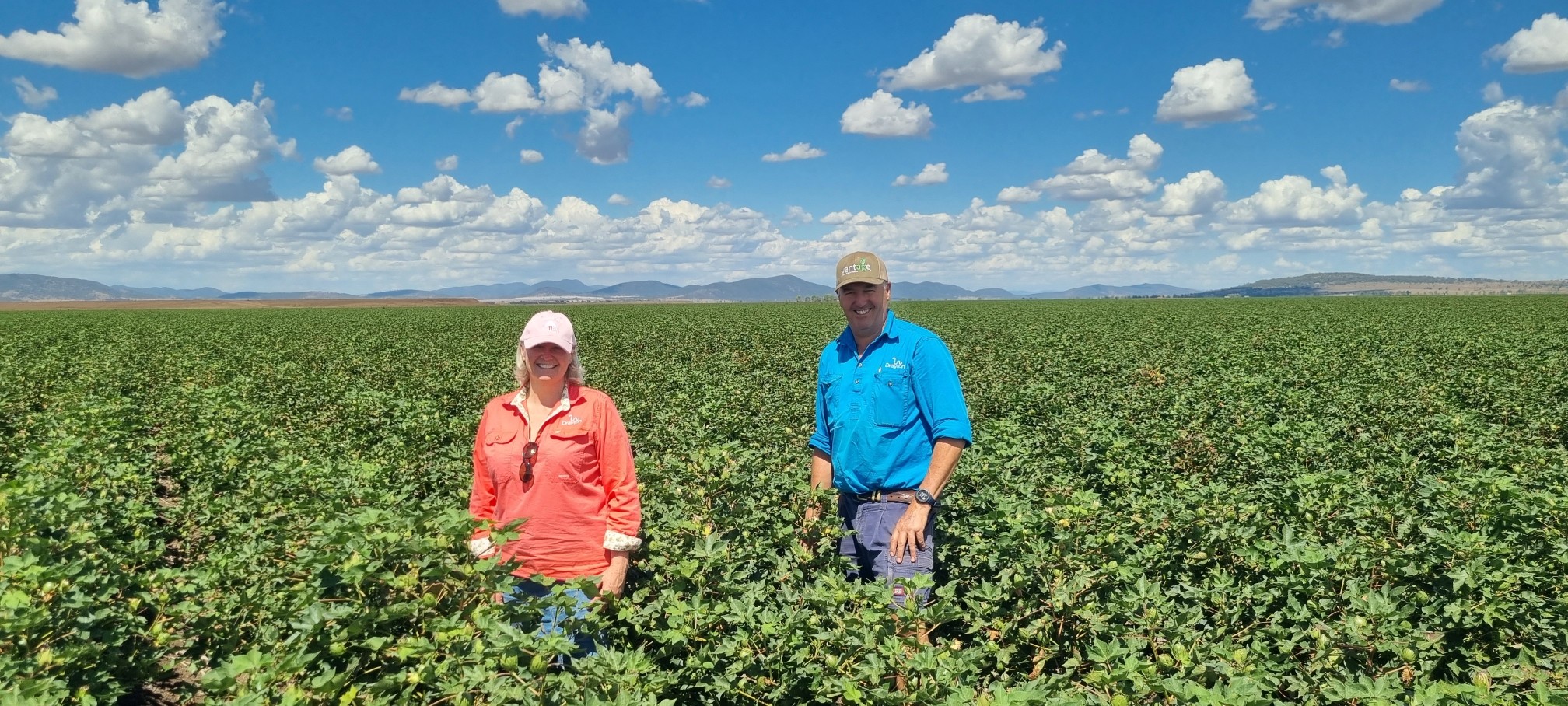
Siblings Juanita (left) and John Hamparsum. Picture: Supplied
Timing is everything when it comes to producing a profitable cotton crop, according to Breeza grower John Hamparsum.
It starts with having sufficient nutrients available to support crop establishment, and continues with careful irrigation management from late December through January to offset heat stress which can reduce yield and fibre quality.
"That peak flowering period is the key, I think, to getting a good fruit load and setting it," Mr Hamparsum said.
"You hope that you get that right and the temperatures aren't too hot. Happy plants, happy life."
In partnership with his sister Juanita, Mr Hamparsum farms about 1500 hectares of mostly self-mulching black vertosol soils at Drayton, on the Liverpool Plains between Breeza and Gunnedah.
About 960ha is set up for irrigated crops, while 240ha is dryland and the balance riparian areas and flood zones adjacent to the Mooki River where cattle grazed until 2002.
The Hamparsums produce winter crops of wheat and canola, and summer crops of cotton and sorghum.
The typical rotation is sorghum, followed by canola, then cotton and wheat.
Green manure cover crops of tillage radish and cereal are ploughed back into the soil to boost organic matter, nutrients and improve soil structure.
Despite average annual rainfall of 624mm, summer cropping is dependent on irrigation.
This is mostly drawn from the Mooki River, which is part of the upper Namoi system catchment and joins the Namoi River northeast of Gunnedah. That water is pumped from the river when it is in high flow and stored on-farm in above ground dams. Bores provide a backup.
"With the unregulated system in a good year, it's fairly reliable, but like in El Nino, which we're going into now - the river stopped flowing a long time ago," Mr Hamparsum said.
Improving water efficiency has been a focus over the past seven years, with half the farm converted from flood furrow and siphons to a pontoon irrigation system.
"It's definitely more efficient," he said.
"We're getting higher yields, water gets on and off much quicker, and the labour savings are incredible. I can get out of bed at two in the morning - like I did this morning - and do a change and have it completed and be back in bed by half past, whereas siphons takes a lot longer and your heart rate gets up so it's hard to get back to sleep."
The new system also opens up the possibility of automation, allowing for even more precise and remote control watering, which Mr Hamparsum plans to start implementing next year.
He usually budgets for 4-4.5 megalitres per hectare, applied three times in-crop or twice in a wetter season.
Preparation for this season's 540ha of cotton began in February 2025 with furrowing, hilling up and fertiliser spreading. As well as urea at 120kgN/ha, a mixture of 41kg of zinc heptahydrate and 30 litres per hectare of molasses was applied at an overall rate of 110L/ha.
Tests since the 1960s have shown the soils are inherently low in zinc, and unsulphured molasses has been added to the zinc blend for the past 20 years to give microbes, such as beneficial bacteria and fungi, an energy boost, aid nutrient cycling and speed up availability of zinc.
Using an 8m John Deere MaxEmerge planter, the cotton was planted at 13 seeds per metre on one metre row spacings, during October.
"We aim for 12 plants to the metre but often end up about 10.5 plants to the metre established by the time black root rot takes its toll," Mr Hamparsum said.
This season's crops include three XtendFlex varieties: Sicot 761B3XF, Siokra 253B3XFand Sicot 619B3XF.
The XtendFlex varieties have won over Mr Hamparsum, who said they had yielded well and provided greater flexibility with herbicides for tackling problem weeds such as sow thistle and fleabane.
A liquid solution of urea and sulphate of ammonia, at an average rate of 120kgN/ha, was injected into the soil during inter-row cultivation in early December and herbicides were applied three times during the season.
The season has been something of a roller coaster to date, with good early growth followed by cold shock in late November and December, a heatwave in January and seven months of "storm lotto" but very little rain.
"The last decent fall of rain we had was in August, when we got 32mm, and ever since then, the biggest rain we've had in one fall is 10mm and there's only been three of those," he said.
"The fruit didn't set until the ninth, 10th node as a result ... with the lack of rain, we used all of our dam water up, and then we've been on bores, and they didn't have the capacity to keep up with two weeks of above 40 degrees, and that took its toll on the cotton."
The extended dry has forced Mr Hamparsum to cancel a planned trial of a summer multi-species cover crop of cow peas and sun hemp, and he's concerned about whether there will be enough rain in the next few months to plant cover crops leading into winter.
"There's a lot of people in the same boat as us," he said.
"It's a lot worse than I think people understand ... I'd say that to look around here now we're as bad as we were in 2019. It's shocking."
Other challenges have included black root rot during the cold snap and verticillium wilt appearing now in some of the cotton that was heat or water stressed. The heat also caused a drop in predatory thrip numbers and there has been a flareup of spider mites.
"We're just monitoring them at the moment," he said.
"We might have to spray them, but we'll see. Normally, we try and get away without it."
Mr Hamparsum was still hopeful yields would be "reasonable", but said it was too soon to speculate on how they might compare to last year's farm average of 11.5 bales.
"We're in a short season area, in the cooler end of the cotton belt, so for us to get over that 10 bale average, we're quite happy with that," he said.
Picking is expected to start in the dryland cotton in mid-April and the irrigated blocks from April 20. Modules will be sent to the gins at Carroll Cotton, Carroll, and Namoi Cotton, Boggabri, for processing.
This article appeared in Australian Cotton & Grains Outlook
