

What global food contamination outbreaks can teach fresh produce growers
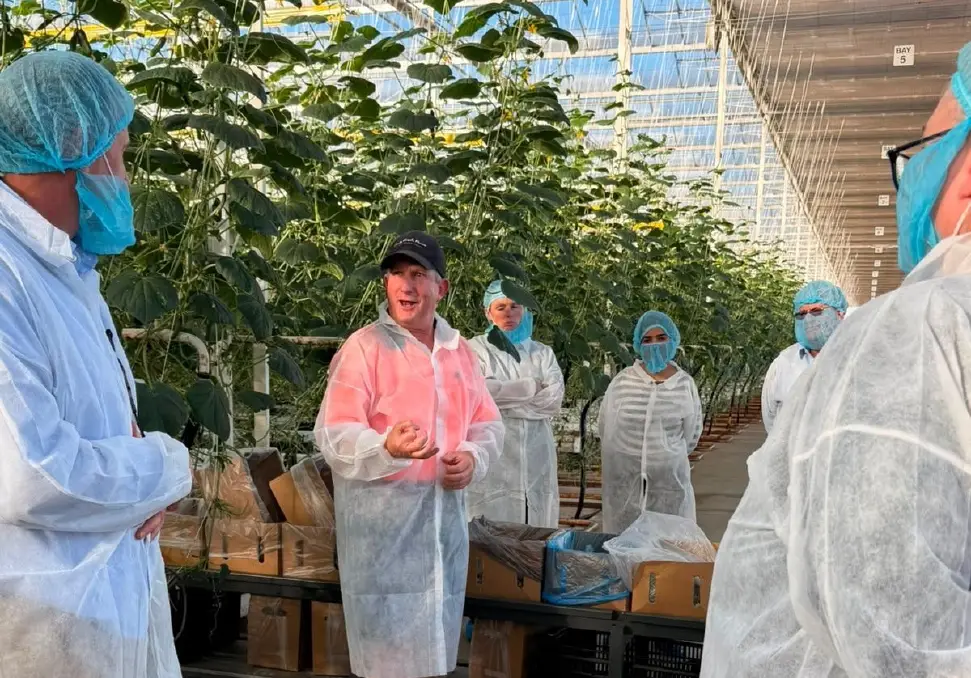
Family Fresh Farms baby cucumber grower Wade Mann explains food safety measures during a tour of the Peats Ridge glasshouses by symposium delegates. Pictures supplied
The day-to-day actions of people determine whether food safety systems, specifications and testing controls work.
That was the message from two keynote speakers at the International Fresh Produce Safety Symposium held in Sydney in July.
Executive director of the Institute for Food Safety at Cornell University Dr Betsy Bihn and UK leafy salad industry representative D'Arcie Rice each used outbreaks of food-borne illness in their home countries to make the case for practical, whole-of-business food safety culture.
Their operating environments differ - the US has extensive university extension networks, national regulation and surveillance systems, while the UK leafy salad sector has limited research capacity and had to build stronger grower collaboration after a serious outbreak.
Australia sits somewhere between with industry assurance programs, research organisations and a diverse production base, but also faces geographically dispersed farms, seasonal workforces and variable weather.
The common issue is that fresh produce is grown in dynamic environments, not controlled factories.
Dr Bihn, who is also director of the Produce Safety Alliance and National Good Agricultural Practices Program in the US, said growers were frequently expected to manage microbial risks without having received formal food safety education during their agricultural training.
"The odd thing about farm food safety, in my opinion, is we expect people that have sometimes had no actual training in food safety to be food safety experts," she said.
Inadequate training costs everyone
Dr Bihn said that gap had consequences, pointing to the impact of the 2006 US spinach outbreak, in which E. coli sickened more than 270 people across numerous states and killed three people.
Sales of spinach did not return to normal for more than a decade afterwards, she said.
Later E. coli outbreaks associated with romaine lettuce also affected retail purchasing, with one retailer reducing the number of products containing romaine from more than 40 to six after successive incidents.
As well as causing illness, disease outbreaks change buyer requirements, increase paperwork and testing, affect consumer confidence and place further cost pressure on farms already working with thin margins.

Food-borne illness costs Australia an estimated $2.81 billion each year.
A 2023 Australian National University report estimated food-borne illness costs Australia $2.81 billion each year.
The report attributed the highest cost to poultry ($328 million), while vegetables cost $107 million and fruit $22.8 million.
Dr Bihn warned against imagining that risk could be eliminated entirely.
"Our understanding and technology is not good enough to be able to drive risks to zero," she said.
"Knowledge, training and practice implementation are key to managing risks."
Dr Bihn said training needed to help people apply knowledge rather than simply recalling it.
Material must be relevant to the job, delivered in a language and format workers can understand, and reinforced through regular short refreshers.

Keynote speaker Dr Betsy Bihn.
It should also account for cultural norms, literacy, seasonal labour and the facilities available on-farm.
"Food safety is contingent on people doing the right thing day in and day out without someone monitoring them at all times," she said.
Source not found
Ms Rice, who manages primary production food safety for major European salad producer G's and leads food safety initiatives for the British Leafy Salads Association (BLSA), described the UK's 2024 E. coli outbreak.
It involved 293 confirmed cases, with 46 per cent requiring hospitalisation.
Of those, 11 people developed haemolytic uraemic syndrome, which can cause sudden kidney failure, and three died.
Based on interviews with those who fell ill, Ms Rice said pre-made sandwiches containing lettuce were identified as a likely vehicle, but no positive food sample confirmed the source.
The uncertainty made responding especially difficult for growers.
The industry faced precautionary product recalls, intensified scrutiny and demands for testing, despite limited laboratory capacity and long turnaround times.
Ms Rice said the subsequent incident report said "it could be lettuce, but it also might not be".
"So we still have nothing. It's laughable, but it's also horrifying," she said.
The BLSA's response was to bring growers, processors, retailers, laboratories and regulators together.
It held a best-practice workshop, invited regulators onto farms and helped develop an enhanced Red Tractor leafy salad audit standard.
It is now developing grower-specific HACCP and food safety training, designed to be affordable, delivered out of season and based on real production examples rather than generic food-manufacturing scenarios.
Building a culture
Ms Rice said a key challenge for the UK was building a food safety culture across a dispersed and changing workforce while maintaining consistency through production pressure, weather events and shifting land bases.
Her model comes from workplace health and safety: make responsibility visible, use common language, enable reporting without blame and learn from near misses.
"The example you walk by is the example you set," she said.
"Culture is what we all do when no one's watching."
Current outbreaks under investigation in the UK include salmonella in imported eggs (528 cases, two deaths).
And in the US, the Centers for Disease Control and Prevention (CDC) had by September 8 reported 19,595 confirmed cases, 1043 people hospitalised and two deaths across 49 states from cyclospora infections linked to processed iceberg lettuce from Mexico
This article appeared in Good Fruit & Vegetables.
