

Why this border cotton grower is planting less after three strong years
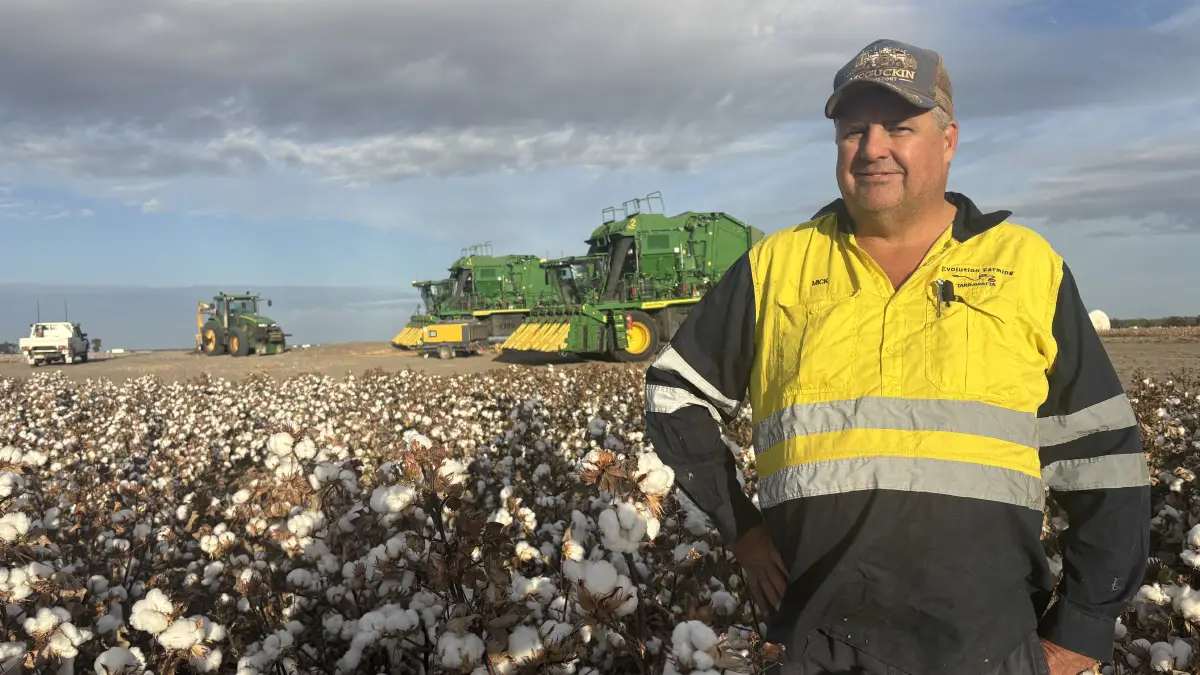
Mick Freeman manages Tarrawatta, midway between Talwood and Mungindi, for Evolution Farming. Picture supplied
After three big years in a row, Border rivers cotton grower Mick Freeman is almost looking forward to some breathing room next season.
"As an irrigator, one year in five you miss out so it must be getting close," he said.
"We haven't got a whole lot of water, so we're probably only looking at a few hundred hectares of cotton at this stage."
With no significant recent rainfall, he said no high flow harvesting events were expected and water from the Queensland and NSW regulated licences would most likely be used at Evolution Farming's Goondiwindi farm.
Mr Freeman said a smaller area of cotton would give them the opportunity to get stuck into the program of replacing pumps - many up to 30 years old - upgrading pipelines, re-levelling fields and addressing drainage issues.
"While you're growing back-to-back cotton, you don't get a chance to fix those things up," he said.
Mr Freeman manages Tarrawatta, midway between Talwood and Mungindi, for Evolution Farming, which is owned by Glen Smith.
About 3000ha is set up for irrigated summer crops of cotton, and another 4500ha is dedicated to dryland farming of winter crops, such as wheat and chickpeas.
The dryland portion also hosts the occasional cotton crop "every couple of years when we have a fallow paddock and a flood that lines up".
The typical dryland rotation is two years of wheat followed by chickpeas, then cotton when conditions suit.
The area planted to irrigated cotton each year depends on how much water is available for irrigation.
Mr Freeman said they often grew dryland wheat when spelling cotton blocks.
"Ideally, we'd like to grow two cotton, then one long fallow wheat crop," he said.
"(But) some of our country's had four crops of cotton in a row, which has paid a bit of a penalty this year.
"I'd say a third of our country was fallow that we grew this year's crop, and two-thirds was planted back onto cotton. Some fields that were fallow and should have grown cotton were also being redeveloped as bankless fields which threw out the rotation."
Mr Freeman said the continuous cotton crops had contributed to compaction and depletion of soil nutrients and structure, as well as patches of fusarium wilt and verticillium wilt, resulting in a 10-20 per cent drop in yields.
"You always grow your best cotton after a fallow," he said.
Preparation for this year's crop started with spreading cow manure - obtained from feedlots - at 10 tonnes a hectare before applying anhydrous ammonia at 250kg/ha and Cotton Sustain pre-plant fertiliser at 250kg/ha.
Hills were then pulled up and beds rolled ready for planting.
This season's 1900ha of irrigated crop was planted on one metre row spacings with Flowphos at 20 litres a hectare from September 30, using a 12m John Deere MaxEmerge planter.
Mr Freeman said the seeding rate was 15 to 16 seeds per metre with the aim of ending up with a stand of 10 plants per square metre.
This season's crops were mainly Siokra 253B3XF, Sicot 619B3XF and Sicot 748B3F.
"Our standard variety has been 748," he said.
"We still grow a bit of 746 and a little bit of 606, but we've had CSIRO variety trials here for several years.
"CSX 1257B3XF and CSX 1320B3XF have had good results in our trials, however seed was limited for this year, but we will probably grow them next season."
Even though yields from the existing XtendFlex varieties have been comparable to Bollgard 3 varieties to date in trials at Tarrawatta, Mr Freeman said tolerance to two more herbicides would be helpful for managing weeds such as fleabane and feathertop Rhodes grass in cotton grown on dryland areas.
"Because of Roundup Ready and tillage, weeds aren't really an issue in the irrigated crop," he said.
"We do have some glyphosate resistant barnyard grass in our irrigation but we can usually manage that."
About 200kg/ha of urea was spread at the cultivating stage before the crop received its first watering in December.
With average annual rainfall of 610mm, Mr Freeman budgets on 10 megalitres of water per hectare of cotton, which was split across nine to 10 applications.
Water is sourced from the Weir and Macintyre river systems and overland flows, and stored in above ground dams, with the capacity to hold 25,000 megalitres.
Crops are irrigated by a combination of flood furrow and siphons, and centre pivots.
An area of about 700ha is being converted to bankless irrigation with a view to improving efficiency.
"We want to increase water infiltration and be more efficient with irrigation," Mr Freeman said.
"That includes having less people starting siphons and less staff demands."
As much as Mr Freeman would like to embrace automation and remote monitoring, adoption continues to be stymied by inadequate phone and internet services.
"We've got high-speed internet into all our houses, the airstrip, silos and workshop, but it doesn't get out in the paddock, unfortunately," he said.
Conditions were cool and wet at planting - combined with varieties with low seedling vigour, this resulted in a few patchy plant stands.
"A few fields had areas of only seven-to-eight plants per metre and if you knew you could replant and get more seeds up, you probably would have," he said.
This was followed by a very dry December, January and February, with only a week of temperatures above 40 degrees, although night-time temperatures stayed high.
Mr Freeman said this made it "a pretty kind season" overall.
The crop received three herbicide sprays by air and no extra insecticide applications were needed.
Picking began in mid-March, with the last module rolled and wrapped at the end of April.
Mr Freeman said the farm average yield three years ago was 15 bales.
"Last year, we only had a 12.5 or 13 bale farm average," he said.
"I think we'll be similar this year. It's been a nice dry pick with good conditions and cotton quality should be nice."
Modules are sent for processing to Mungindi Ginning, which is also owned by Mr Smith.
This article appeared in Australian Cotton & Grains Outlook
